
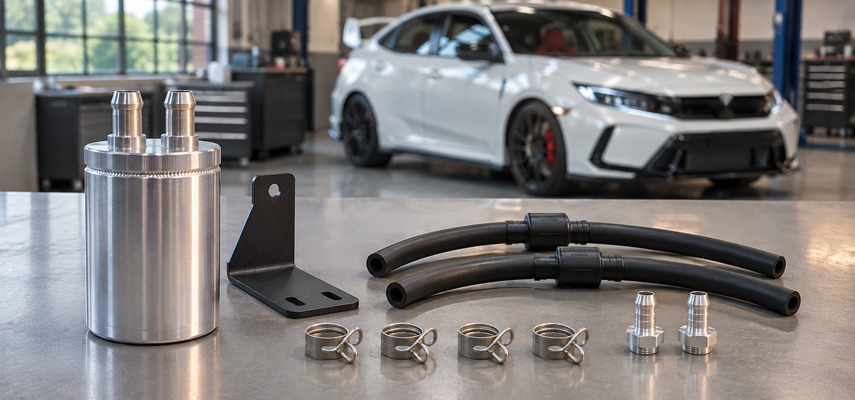

A Honda Civic Type R does not strictly need an oil catch can on a stock street car, but a baffled can on the PCV side is a low-cost way to reduce the oil vapor the K20C1’s crankcase ventilation sends into the intake, and it matters most for track days and hard driving. Mishimoto’s kit for the FK8 and FL5 mounts on the firewall, installs in under 30 minutes by Mishimoto’s estimate, and needs its contents checked every 1,000 miles until a baseline is set. Owners report catching anywhere from almost nothing to a visible amount, so the benefit depends on how the car is driven.
Wrench Masters is a performance parts shop in St. Petersburg, FL that sells Civic Type R parts for both generations and has a Type R specialist available on WhatsApp. Catch cans are one of the most debated Type R mods, and most of what is written about them comes from the companies that sell them. This guide separates what is established from what is claimed, and explains who is likely to benefit.
Which Civic Type R Does the Catch Can Fit?
| Car | Fits | What to know | Best for |
|---|---|---|---|
| FK8, 2017 to 2021 | Yes, including the 2021 Limited Edition, per dealers | Left-hand drive only, and the kit covers the PCV side of the system | Track days, hard driving, and owners who want preventive protection |
| FL5, 2023 and newer | Yes, per Mishimoto’s FK8 and FL5 chassis listing | Same K20C1 engine and the same kit, so confirm your year on the product page | Track-driven FL5 owners |
| Stock street car | Fits either generation | Owner reports suggest little oil is caught in light use | Owners who want an inexpensive precaution |
Dealers list the kit for the 2017 to 2021 and 2023 and newer cars, while one dealer lists only 2017 to 2020, so owners should check the year on the product page before ordering. Mishimoto lists the chassis codes as FK8 and FL5 and the engine as the K20C1.
Do You Need an Oil Catch Can on a Civic Type R?
It depends on how the car is used. For a stock street car, the case is weak, because the evidence that a can prevents a problem on this engine is mostly manufacturer claims. Track use and sustained high load make a stronger case, since blow-by rises under heavy load and the car’s crankcase vapors pass into the intake.
Owner experience varies. One FL5 owner on a Civic XI forum reports running a PCV-side can for several thousand miles, including a track session, and catching only a drop or two. Another owner with several turbocharged cars says catch cans typically catch a decent amount and calls the can cheap insurance. Those are individual reports, not a controlled test.
What Does a Catch Can Do on a Direct-Injection Engine?
The K20C1 is turbocharged and direct injected. Mishimoto says that combination leaves the top end susceptible to blow-by symptoms, such as clogged intake valves and oil coating the intercooler internals. AIRTEC Motorsport, a UK maker of catch cans, describes carbon build-up on the intake valves as a known issue with direct-injection engines, and explains that the PCV valve lets blow-by gases pass from the crankcase back into the intake manifold.
The logic is that a catch can separates oil from those vapors before they reach the intake. It does not clean valves that already have deposits, and it cannot eliminate blow-by. What it does is reduce how much oil vapor travels into the intake over time.

What Does the Mishimoto Kit Include?
The kit includes a 6061 aluminum can with an internal air diverter and a 50-micron bronze filter, an application-specific firewall bracket, two direct-fit hoses with an integrated check valve, spring clamps, and aluminum barbed fittings. Mishimoto says the check valve keeps boost pressure from reaching the can and the crankcase. The bracket comes in black or Rallye Red, and Mishimoto backs the kit with a lifetime warranty.
Capacity is listed as 2 oz on Mishimoto’s page, while some dealer pages say 3 oz, so treat the smaller number as the safe one. The can mounts in a serviceable location on the firewall, and it is a left-hand-drive kit only.
PCV Side or CCV Side: Do You Need Both?
AIRTEC, which sells separate PCV and CCV kits for the FK8, says the car has both a PCV path and a CCV path, and the Mishimoto kit covers only the PCV side. AIRTEC says the CCV port vents directly from the crankcase to the intake under heavy load, and recommends fitting both for the most protection. That is one maker’s view, and no independent source reviewed settles whether a PCV-side can alone is enough.
A single PCV-side can is the practical starting point, since Mishimoto’s direct-fit kit covers both generations. Owners who track the car heavily may want to research the second side.
How Often Do You Need to Empty It?
Mishimoto recommends checking the can every 1,000 miles after installation until a baseline is established. It warns that the contents must never rise above the internal baffle, and that accumulation varies with ambient temperature and driving conditions. A car that sees sustained track sessions will fill a can faster than a car that commutes.
That maintenance is the real cost of a catch can, more than the purchase price. A can that is never emptied stops doing its job.
Does a Catch Can Affect the Warranty or Emissions?
Owners ask both questions, and the answers depend on the car and the state. A catch can changes the crankcase ventilation path, so a warranty claim involving the engine could prompt questions, and owners should ask their dealer about Honda’s policy before installing. The sources reviewed do not list a CARB Executive Order for this kit, and because the PCV system is part of the emissions design, owners in CARB states should ask the Wrench Masters team before ordering.
Where Can You Read More?
The most common Civic Type R failures guide covers the weak points owners watch, and the coolant tank problem guide covers one of the best known. Owners planning more power can read how much boost is safe on a stock Civic Type R and how much power a stock Civic Type R can handle, and the stock versus upgraded turbo guide explains the next step.
Each generation has its own first-upgrades list, with the FK8 specs guide for the earlier car and the FL5 first upgrades guide for the newer one. The FK8 versus FL5 guide explains how the two differ, and E85 versus pump gas covers the fuel side of a tuned build. More guides sit in the Honda blog category.
Frequently Asked Questions
Does a Civic Type R need an oil catch can?
Not strictly on a stock street car. A baffled PCV-side can is a low-cost precaution that matters most for track days and hard driving.
Does the Mishimoto catch can fit the FL5?
Mishimoto lists the kit for the FK8 and FL5 chassis and the K20C1 engine, and dealers list the 2017 to 2021 and 2023 and newer cars. It is for left-hand-drive cars only.
How often do I empty a Civic Type R catch can?
Mishimoto recommends checking it every 1,000 miles until you establish a baseline. The contents must never rise above the internal baffle.
How much oil does a Type R catch can catch?
It varies. One FL5 owner reports a drop or two over several thousand miles including a track session, while other owners report catching more, depending on driving and temperature.
Does a catch can stop carbon buildup on the intake valves?
It reduces the oil vapor that reaches the intake, which is a contributor to deposits on direct-injection engines. Existing deposits stay in place, and blow-by is not eliminated.
Will a catch can void my Honda warranty?
Ask your dealer about Honda’s policy before installing. A catch can changes the crankcase ventilation path, so engine claims may prompt questions.
0 Comments for “Do You Need an Oil Catch Can on a Civic Type R?”