
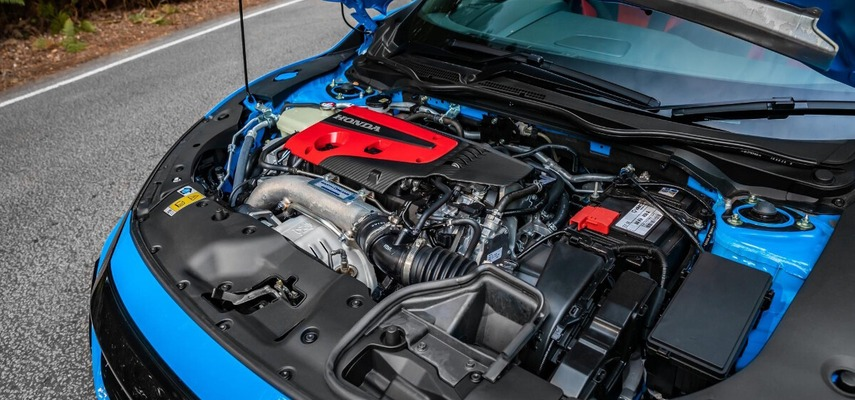

The K20C1 in the Honda Civic Type R has earned a reputation as one of the stronger factory turbo engines Honda has ever built, and the real-world evidence backs that up. But “how much can it handle” does not have one clean answer, the community has seen everything from cautious warnings around 400 horsepower to a fully documented 620 horsepower build running the completely stock long block. This post covers where the real limits actually sit, why the fuel system matters more than the engine internals for most owners, and how to think about a realistic power target for your own build.
What Makes the K20C1 Different From Older Honda Engines
Unlike the naturally aspirated K-series engines Honda built its reputation on, the K20C1 was designed from the ground up as a turbocharged engine, not adapted from an existing platform. It uses a forged steel crankshaft and forged connecting rods, an aluminum block and head, and F1-derived oil cooling galleries aimed directly at the piston undersides to manage heat under boost. This is a meaningfully more robust factory bottom end than Honda has historically shipped, and it is a big part of why the engine has developed a reputation for tolerating real power increases without needing to be opened up.
The engine’s factory application beyond the road car reinforces this reputation too. The same K20C1 architecture underpins Honda’s involvement in F4 and F3 feeder series, British Touring Car racing, and IMSA competition, applications that demand an engine capable of sustained high load without the kind of factory safety margin built into a typical daily driven car. That racing pedigree does not mean a street car can be driven like a race engine, but it does explain why the factory bottom end has more genuine headroom than most turbocharged four cylinders on the market.
The Wide Range of Reported Safe Limits
One professional engine builder has been quoted describing rods bending around 400 horsepower on engines they have worked with, a caution worth taking seriously coming from someone who has actually had these engines apart. At the same time, a well documented 2026 build using Hondata cams, a larger turbo, and E85 fuel produced 620 crank horsepower on a completely stock long block, retaining the factory clutch and gearbox as well. Both data points are real. The difference between them comes down to tune quality, boost strategy, and how the car gets driven, not a flaw in either account.
The Real Bottleneck: Fuel Delivery, Not Internals
Across multiple independent community discussions, the same conclusion keeps surfacing. Owners chasing more power consistently run into fuel delivery limitations before the engine internals become the actual concern. The stock fuel pump, not the block, the rods, or the pistons, is what most builds hit first. A fuel system starved under boost creates a lean condition, and a lean condition under load is what actually causes the kind of engine damage that gets misattributed to “weak internals” when the real cause was insufficient fuel delivery the entire time.
What a Staged Power Progression Typically Looks Like
Community-reported figures, not official Honda specifications, suggest a rough progression as modifications stack up. A Stage 1 ECU remap on 93 octane commonly yields somewhere in the 340 to 360 horsepower range with no hardware changes. Adding an intake and downpipe on top of that tune often pushes into the 360 to 380 range. A full Stage 2 setup with a front mount intercooler, catless downpipe, and supporting fuel system commonly reaches 380 to 420 horsepower. The stock IHI turbocharger itself is generally considered maxed out somewhere around 380 to 400 horsepower, which is why builds targeting significantly more power move to larger turbos rather than continuing to push the factory unit past its efficiency range.
When Injectors and Fuel Pump Actually Need Attention
Stock injectors are commonly cited as adequate to roughly 400 horsepower with proper tuning before needing an upgrade, closely tracking the same range where the stock turbo itself starts running out of room. This is not a coincidence, these systems were sized together at the factory, so they tend to reach their limits around the same power level. Past that point, an upgraded fuel pump, larger injectors, and often flex fuel capability become part of the conversation rather than optional extras, which mirrors almost exactly the same pattern seen on turbocharged platforms across other brands, once one component in the fuel delivery chain gets upgraded, the next one in line tends to become the new limiting factor.
Where Rod and Piston Strength Actually Enters the Picture
Commonly cited community estimates place factory rod and piston strength as reliable up to roughly 450 horsepower with proper tuning and quality fuel, a number that lines up reasonably well with the professional builder’s more cautious 400 horsepower warning once normal safety margin is factored in. The 620 horsepower example sits well beyond that range, which is exactly why it stands out as a notable outlier rather than a typical result, it required a specifically built fuel system, ethanol fuel, and careful tuning to get there safely on stock internals, not a simple bolt-on progression.
What Actually Separates a Safe Build From a Failed One
It is worth being honest about what separates a typical stock-internal build from an outlier like the 620 horsepower example. The gap is not luck, it comes down to how precisely every supporting system was matched to the power target before boost was ever raised. A fuel system sized correctly for the target horsepower, cooling capable of managing sustained heat rather than a single dyno pull, and a tune built specifically around that combination of parts rather than a generic off-the-shelf map are what separate a build that reaches an aggressive number safely from one that fails trying to get there. Skipping any of those steps to chase a number faster is exactly how engines that could have handled the power end up damaged instead.
What This Means Depending on Build Goals
For most owners, the practical ceiling on a stock long block sits somewhere in the 400 to 450 horsepower range once fuel system upgrades are factored in alongside a turbo and supporting mods. Pushing meaningfully past that, into 500 or 600 horsepower territory, is possible on a stock block as demonstrated, but it demands a level of fuel system, cooling, and tuning precision that goes well beyond a typical staged bolt-on build. Anyone targeting that upper range should plan the fuel system and cooling upgrades as seriously as the turbo itself, rather than treating them as an afterthought once boost climbs.
For a broader look at how the FK8 and FL5 platforms compare as a foundation for a build like this, the post on FK8 vs FL5, what actually changed covers the chassis and platform differences that matter alongside engine power decisions. For a look at how a real build comes together on this platform, the post on Honda Civic Type R FK8 street hatch build covers what a well executed build actually looks like in practice.
Frequently Asked Questions
Can a Civic Type R really make 600 horsepower on a stock engine?
A documented 2026 build achieved 620 crank horsepower on a completely stock long block, though it required a larger turbo, E85 fuel, and careful tuning. This is a notable outlier rather than a typical result from a standard bolt-on progression.
What usually limits Civic Type R power before the engine internals do?
The stock fuel pump is the most commonly cited limiting factor. Fuel delivery issues under boost frequently get misattributed to weak engine internals when insufficient fuel supply was the actual root cause.
At what power level does the stock turbo need to be upgraded?
The stock IHI turbocharger is generally considered maxed out somewhere around 380 to 400 horsepower, which is when builds targeting more power typically move to a larger aftermarket turbo.
How much power can stock rods and pistons actually handle?
Community estimates commonly place reliable capacity around 450 horsepower with proper tuning and quality fuel, though this is not an official Honda specification and real-world results vary based on tune quality and driving habits.
Why do some stock-internal builds fail while others reach 600 horsepower safely?
The difference usually comes down to how precisely the fuel system, cooling, and tune were matched to the power target before boost was raised, rather than any inherent weakness in the engine itself.