
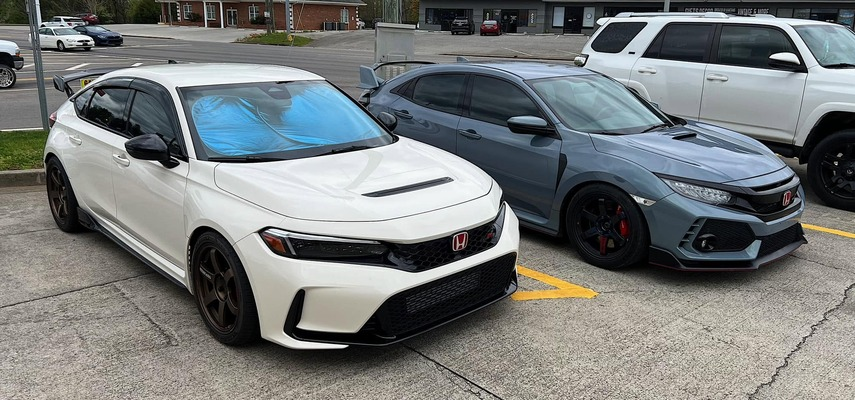

On paper, the FK8 and FL5 Honda Civic Type R look like a modest update, a few more horsepower, a slightly bigger footprint. On the track, the gap is anything but modest. The FL5 lapped the Nürburgring in 7:44.13, nearly 29 seconds faster than the FK8’s 8:13. This post breaks down what actually changed between the two generations, why that gap is bigger than the spec sheet suggests, and what it actually means for anyone shopping between them.
The Engine Looks the Same, and Mostly Is
Both cars run the same K20C1, Honda’s turbocharged 2.0 liter inline-four with direct injection. Same block, same heads, same fundamental architecture. The FK8 makes 306 horsepower and 295 lb-ft of torque in US spec. The FL5 bumps that to 315 horsepower and 310 lb-ft, a modest gain that comes from a more efficient turbocharger, a revised intake, and a refined exhaust rather than any major internal changes. On raw numbers alone, this looks like an incremental update. It is not the reason the FL5 is dramatically faster around a track.
Where the Real Difference Actually Lives: The Chassis
The FK8 is built on Honda’s 10th generation Civic platform. The FL5 moves to the 11th generation chassis, and this is where the meaningful gap opens up. Wheelbase grew by roughly 35mm, and track width widened front and rear, giving the FL5 a wider, more planted stance. Honda also added structural bonding points throughout the chassis, increasing torsional rigidity significantly and rear-end rigidity even more, numbers that translate directly into a car that flexes less and communicates the road more precisely at the limit.
This chassis difference is really the whole story behind the Nürburgring gap. A stiffer structure means suspension geometry stays more consistent through hard cornering loads, since less energy gets absorbed by chassis flex rather than being managed by the suspension itself. That consistency is what separates a car that feels planted lap after lap from one that starts to feel unpredictable once tires and chassis both start working hard simultaneously. The FK8 was never a flimsy car by any measure, but the FL5’s structural gains are large enough to change how the car behaves at the actual limit, not just how it feels driving normally.
Weight Went Up, But Not Where It Hurts
Despite the larger footprint, the FL5 is only about 70 pounds heavier than the FK8, a modest gain considering the chassis grew in every dimension that matters for rigidity. Honda offset some of that growth deliberately, an aluminum hood roughly 43 percent lighter than the FK8’s steel unit, and a notably lighter flywheel that sharpens throttle response and rev matching. The net effect is a car that feels quicker to react even where it carries slightly more mass overall.
Smaller Wheels, Counterintuitively, On Purpose
One detail that surprises people who assume bigger is always better: the FK8 rides on 20 inch wheels, while the FL5 actually steps down to 19s. This was a deliberate choice, smaller wheels mean more tire sidewall and less unsprung weight, both of which improve ride compliance and grip consistency over real road surfaces without sacrificing track capability. It is a good reminder that wheel size decisions on a serious performance car are rarely about looks alone, and that a smaller number on a spec sheet does not automatically mean a step backward.
Suspension geometry also received real attention beyond the chassis itself. Honda revised the lower suspension arms on the FL5 for improved camber rigidity, translating into sharper turn-in response that owners and reviewers have consistently noted in back to back comparisons with the FK8. Combined with the wider track and stiffer chassis, the FL5’s cornering behavior reflects a genuinely different level of suspension refinement rather than just incremental tuning changes carried over from the previous generation.
The Detail That Actually Matters for Parts Buyers
This is the part most comparison articles skip, and it matters more than any spec sheet number if you actually own one of these cars. Because the FK8 and FL5 share the same core engine family, it is tempting to assume parts cross over between them. They largely do not. Intake routing, cooling packaging, exhaust fitment, mounting brackets, and body components all differ by chassis generation, even where the underlying engine is closely related. Universal hardware, certain hoses, and some interior accessories may cross over, but anything tied to the chassis itself, suspension components, exterior aero, cooling system parts, needs to be sourced specifically for FK8 or FL5, not assumed interchangeable because the engine badge matches.
This distinction matters just as much for anyone considering a swap or crossover project as it does for a straightforward parts purchase. Even bolt-on categories that seem generic, an intercooler or a catback exhaust, are engineered around the specific packaging of each chassis, and forcing a part designed for one generation onto the other often means fabrication work that erases whatever value the part offered in the first place. Confirming chassis-specific fitment before ordering is the single most important habit for anyone shopping either platform.
A Brief Word on the FK2
Before the FK8 brought the Civic Type R back to the US market in 2017, the FK2 generation existed only for European and Japanese markets. It never officially reached the United States, which is part of why the FK8’s arrival felt like such a significant moment for American Honda enthusiasts, a genuinely track-focused Type R was finally available here after years of the nameplate existing only as an import fantasy. The FK2 is largely a footnote for US owners today, but it explains why the FK8 gets treated as such a landmark car in the US Honda community specifically, rather than just another entry in a long-running nameplate.
Which One Is the Better Foundation for a Build
Neither answer is universally correct, it depends on priorities. The FK8 remains the better value on the used market, with a mature aftermarket, proven modification paths, and a rawer, more dramatic character that plenty of enthusiasts specifically prefer. The FL5 costs significantly more but offers a stiffer, more capable chassis foundation, better cooling out of the box, and a modification ecosystem that is younger but growing quickly as tuners like Hondata, COBB, and KTuner build out ECU support. For anyone planning serious track use over the long term, the FL5’s structural advantages give it more headroom to build into. For anyone prioritizing value and an already mature parts market, the FK8 remains a legitimately excellent platform.
For a look at how the FK8 platform performs as a street-focused build, the post on Honda Civic Type R FK8 street hatch build covers what a well executed FK8 build actually looks like in practice.
Frequently Asked Questions
Do FK8 parts fit an FL5, since they share the same engine?
Generally no. Despite sharing the K20C1 engine family, intake routing, cooling packaging, exhaust fitment, and chassis-specific components differ between the two generations and should not be assumed interchangeable.
Is the FL5 actually faster than the FK8, or just newer?
Genuinely faster. The FL5 ran a Nürburgring lap nearly 29 seconds quicker than the FK8, a gap driven primarily by chassis rigidity and suspension improvements rather than the modest horsepower increase.
Why does the FL5 use smaller wheels than the FK8?
Honda deliberately stepped down from 20 inch wheels on the FK8 to 19s on the FL5 to allow more tire sidewall and reduce unsprung weight, improving ride compliance and grip consistency.
Which platform has better aftermarket support right now?
The FK8 has a more mature aftermarket given its longer time on the market. The FL5’s support is younger but growing quickly, with ECU tuning platforms and intake and exhaust options already available.
Should I worry about parts fitment if I am buying a used FK8 or FL5 with existing modifications?
Yes. Confirm any installed aftermarket parts were actually built for that specific chassis generation, since incorrect crossover parts can mean compromised fitment or performance even if they appear to physically install.