
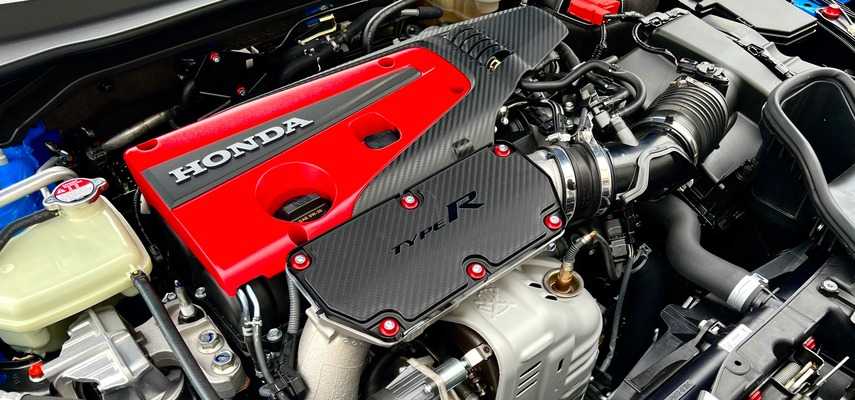

The factory MHI turbocharger on the Honda Civic Type R is genuinely well matched to the car as delivered, responsive spool, minimal lag, and enough airflow to support the factory power output with room for mild tuning gains. But every turbo has a ceiling, and the K20C1’s factory unit reaches its limit sooner than a lot of owners expect. This post covers where that ceiling actually sits, what changes with an upgrade, how to choose between the two very different paths an upgraded turbo can take, and what each path actually costs beyond the price of the part itself.
Where the Stock Turbo Actually Maxes Out
With a tune and supporting bolt-ons, the stock turbo is commonly documented reaching somewhere around 380 to 400 horsepower before it runs out of usable airflow. Past that point, more boost stops translating into meaningful additional power, since the compressor is already working outside its efficient range. This is the same ceiling the fuel system tends to approach around the same time, which is not a coincidence, Honda sized the turbo and fuel system together for the factory power target with a similar amount of headroom built into each.
Two Very Different Categories of Turbo Upgrade
Once a build actually needs more airflow than the stock turbo can provide, there are two meaningfully different paths, and they are not interchangeable decisions. Stock-location “drop-in” turbos retain the factory oil and coolant lines, the factory wastegate actuator, and the factory mounting location, installing largely like a direct replacement rather than requiring a custom exhaust manifold or external wastegate plumbing. Larger aftermarket turbo kits step outside that factory footprint entirely, trading a more involved install for a substantially higher power ceiling.
What Drop-In Turbos Actually Deliver
Drop-in options span a wide range depending on the specific unit. Some are tuned specifically to preserve the stock turbo’s responsive character while extending the top end, one documented stock-location option showed roughly a 54 horsepower gain over stock with minimal added lag, focused on stronger pull through the upper RPM range rather than dramatically more peak power. Other drop-in units target considerably more, several ball bearing stock-location turbos on the market are rated for 500 to 600 horsepower while still bolting into the factory location using the factory oiling and wastegate hardware. The tradeoff as power targets climb within this category is typically a bit more lag lower in the rev range, even while keeping the simpler stock-location install.
Real world track testing on some drop-in options backs up these gains in a way that goes beyond a dyno chart. One documented stock-location upgrade produced a measurable lap time improvement, along with a real increase in top speed at the end of a straight, tested at an actual circuit rather than just estimated from horsepower figures alone. This matters because a dyno number does not always translate directly into how a turbo actually behaves across a full lap, where sustained load and repeated throttle transitions matter as much as peak output.
What Bigger Turbo Kits Actually Require
Kits built around a genuinely larger turbo, capable of 600 horsepower and beyond, generally require more than just bolting on a new compressor housing. Supporting fuel system upgrades become mandatory rather than optional at this level, and many of these kits are built with the expectation of E85 or a similar ethanol blend to safely support the higher cylinder pressures involved. Cooling capacity also needs to scale accordingly, since a bigger turbo generates meaningfully more heat that a stock-spec cooling system was never sized to manage. This is not a bolt-on upgrade in the same sense a drop-in turbo is, it is closer to a full supporting build built around the turbo as the centerpiece.
Spool Time Is the Real Tradeoff, Not Just a Marketing Line
Every turbo upgrade on this platform involves some tradeoff between spool responsiveness and peak airflow capacity, and marketing copy that claims otherwise deserves some skepticism. A turbo sized to deliver dramatically more peak power almost always spools a bit later than the factory unit or a conservatively sized drop-in option, simply because a larger compressor and turbine take more exhaust energy to spin up to an efficient operating range. Some manufacturers have specifically engineered drop-in options to minimize this tradeoff at moderate power increases, but the underlying physics do not disappear entirely at any power level. Anyone comparing turbo options should weigh how the car needs to feel day to day just as seriously as the peak number on a dyno sheet.
What the Install Actually Involves
The install itself differs meaningfully between the two categories as well, and this is worth factoring into a realistic timeline, not just a budget. A drop-in turbo swap on a stock-location unit is generally a job most experienced home mechanics or independent shops can complete in a day, since it largely mirrors replacing the factory part in place. A larger kit involving a custom manifold, external wastegate plumbing, and often intercooler piping changes is a multi-day job even for an experienced shop, and getting it wrong in the install creates problems no amount of tuning can fully correct afterward. Anyone weighing the two options seriously should factor in downtime and labor cost alongside the parts themselves.
What Else the Budget Actually Needs to Cover
The total cost of a turbo upgrade rarely stops at the turbo itself, and this is where budgeting mistakes happen most often. A drop-in turbo targeting a moderate power increase may need little beyond the turbo and a tune. A bigger kit almost always brings a fuel pump, injectors, and often a full flex fuel setup along with it, plus the labor cost of a more involved install if it is not being done at home. Pricing out the realistic total for a given power target before committing to a specific turbo avoids the common trap of buying a turbo capable of far more than the rest of the build is actually set up to support safely.
Matching the Turbo to the Actual Build Goal
A build targeting a meaningful but moderate step up, into the 450 to 500 horsepower range while keeping daily drivability close to stock, is generally better served by a stock-location drop-in turbo than by jumping straight to a larger kit. A build with track ambitions and a genuine target well past 500 horsepower needs the bigger kit’s headroom, along with the supporting fuel and cooling upgrades that come with it. Choosing based on the actual target rather than defaulting to the biggest available option avoids paying for capability, and accepting the tradeoffs, that a more modest upgrade would have covered just as well.
For context on where fuel delivery starts becoming the limiting factor regardless of which turbo path gets chosen, the post on how much power can a stock Honda Civic Type R handle covers that ceiling in more depth. For how boost control itself factors into a turbo upgrade decision, the post on how much boost is safe on a stock Civic Type R covers the electronic wastegate behavior relevant to both stock and upgraded turbo setups.
Frequently Asked Questions
At what power level does the stock turbo actually become the limiting factor?
Commonly documented around 380 to 400 horsepower, where additional boost stops producing meaningful power gains because the compressor is operating outside its efficient range.
Do all turbo upgrades require a custom exhaust manifold?
No. Stock-location drop-in turbos retain the factory mounting, oiling, and wastegate hardware, avoiding the custom manifold and plumbing that larger aftermarket turbo kits typically require.
Does a bigger turbo always mean worse throttle response?
Generally, some tradeoff exists, since a larger compressor and turbine require more exhaust energy to spool. Some drop-in options are specifically engineered to minimize this at moderate power increases, but the tradeoff does not disappear entirely at higher power targets.
Do I need to switch to E85 for a turbo upgrade?
Not for a modest drop-in upgrade in most cases, but kits targeting 600 horsepower and beyond commonly require E85 or a similar ethanol blend to safely support the higher cylinder pressures involved.
What other costs should I budget for beyond the turbo itself?
A drop-in turbo at a moderate power target may only need a tune, while larger kits commonly require a fuel pump, injectors, and sometimes flex fuel capability, along with more involved installation labor.