
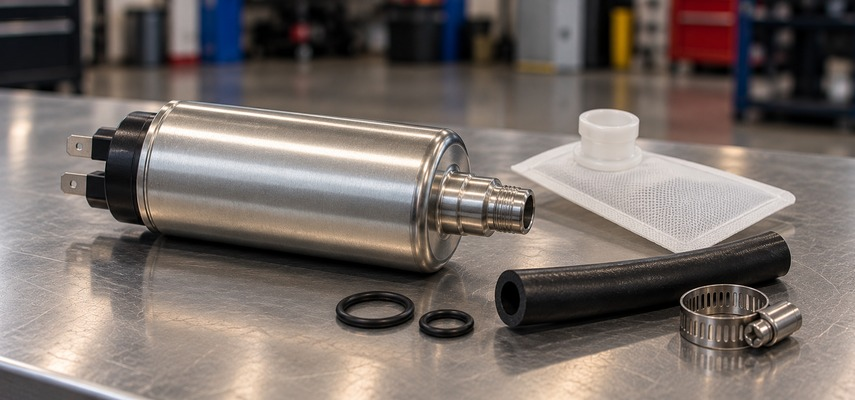

Most Honda Civic Type Rs do not need a fuel pump upgrade. Hondata, which sells fuel system upgrades for the car, says the stock in-tank pump is adequate up to roughly 500 horsepower on flex fuel or 550 on high-octane race fuel, and that an upgrade becomes necessary when direct injection fuel pressure starts dropping under load. The DeatschWerks DW300C is a 340 LPH, ethanol-compatible replacement for owners who reach that point, and it costs about $189.
Fuel pumps get recommended in almost every Type R build thread, usually with little explanation. The real answer depends on how the car makes power, what fuel it runs, and which part of the fuel system is actually the limit. This guide explains how the K20C1 fuel system works, when the in-tank pump matters, and what the DW300C does and does not fix.
How the Type R Fuel System Works
The K20C1 is a direct injection engine, so its fuel system has two stages. A low-pressure pump inside the tank sends fuel up to the engine, and a camshaft-driven high-pressure pump then raises the pressure for the injectors, which spray fuel directly into the cylinders. The in-tank pump is the first stage, and its job is to keep the high-pressure pump supplied.
That layout matters because the two pumps limit power in different places. Hondata states that the stock fuel system as a whole is the primary bottleneck on the FK8, and its own upgrade replaces the high-pressure pump, injectors, and fuel lines, with the in-tank pump as an optional piece. Owners who only upgrade the in-tank pump are fixing the first stage of a two-stage system.
When the Stock In-Tank Pump Becomes the Limit
The listing for Hondata’s own in-tank pump kit gives a clear threshold. It says the kit is designed for direct injection builds making more than about 500 horsepower on flex fuel or 550 on high-octane race fuel, and that up to those power levels the stock in-tank pump is adequate to supply the direct injection pump. That is Hondata’s guidance, and individual cars vary.
The signal to watch is direct injection fuel pressure. Hondata’s guidance says that if the pressure drops while the engine is under load, the in-tank pump is no longer keeping up and needs upgrading. A tuner or a data logger shows that drop clearly, which makes it the most reliable sign, ahead of any horsepower number.
Most street cars sit far below these limits. A stock or lightly modified Type R, even one on a tune, rarely reaches the point where the in-tank pump is the weak link. The posts on how much power a stock Civic Type R can handle and how much boost is safe on a stock Civic Type R explain where the factory hardware reaches its limits.
Where E85 Changes the Picture
Ethanol raises fuel demand, because the engine needs more fuel by volume to make the same power. That is why E85 conversions put more strain on the fuel system than pump gas does, and why the threshold in Hondata’s guidance is lower for flex fuel than for race gas. Owners considering ethanol should read the E85 versus pump gas guide for the Civic Type R first.
One point of confusion deserves a direct answer. The E85 guide explains that the stock high-pressure fuel pump limits how much boost a flex fuel setup can safely run as ethanol content rises. That is the second-stage pump, and the DW300C does not replace it. An in-tank pump upgrade does not lift that limit by itself, which is why Hondata’s complete system swaps the high-pressure pump and the injectors.
An E85 setup also needs components rated for ethanol, which includes any replacement pump. The stock in-tank pump may not be the weak link at moderate power, but whatever pump goes in should be ethanol compatible, and the DW300C is.
DeatschWerks DW300C: What It Is
The DeatschWerks DW300C is a compact in-tank fuel pump that flows 340 liters per hour at 40 psi. DeatschWerks describes it as the highest flow available in a compact fitment, with a quiet turbine impeller, and it is E85 compatible through carbon commutators and a fully encapsulated armature. The pump body is 39 mm in diameter, and the company backs it with a three-year no-fault warranty.
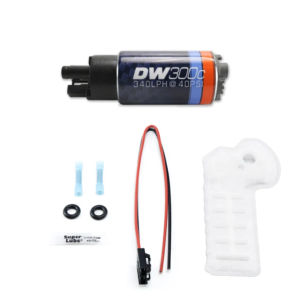
That puts it above the 300 LPH ethanol-rated pump in Hondata’s own in-tank kit, and it fills the same role in the system. It supports the high-pressure pump, so it only helps when the first stage is the limit. Owners who add it to a car that is limited elsewhere will not see a change.
Fitment and What the Listing Includes
The DW300C part 9-307-1059 is listed for the 2017 to 2021 Civic Type R (FK8), and one dealer also lists the 2023 and 2024 Type R (FL5). Dealers do not agree on the newer car, so owners of an FL5 should confirm fitment for their year on the product page before ordering.
The Wrench Masters listing is the pump only. That matters, because some versions of this pump ship with an install kit that includes mounting clips and a filter sock, and this one may not. Owners should check whether the factory filter sock, seals, and retaining hardware can be reused, or whether they need replacements before the old pump comes out.
Installation Notes
The pump sits inside the fuel tank, which makes it a job worth planning. Hondata notes that removing the in-tank pump’s securing ring takes a Honda special tool, part number 07AAA-TBAA100. Working with a low fuel level makes the job cleaner and safer.
The Wrench Masters shop in St. Petersburg installs performance parts, and appointments can be scheduled online. A shop also has the tools to confirm that fuel pressure holds up under load afterward, which is the whole point of the upgrade.
Who Should Buy a Pump, and Who Should Wait
The pump makes sense for three kinds of owner. One is anyone whose logs show direct injection fuel pressure dropping under load. Another is an owner building toward the power levels Hondata cites, especially on E85. The last is a car that sees sustained track loading, where the logs show whether fuel pressure holds.
Everyone else should wait. A stock turbo car on pump gas has little use for this part, and the money is better spent where the car is actually limited. The stock versus upgraded turbo guide explains where power gains start to demand more from the fuel system, and the most common Civic Type R failures guide covers what tends to break first.
Fuel Pumps Versus Injectors
Every platform raises the same question, and the logic carries over. The guide on fuel pumps versus injectors was written for the WRX and STI, but it explains why the right upgrade depends on where the fuel system runs out. On a direct injection car like the Type R, the high-pressure pump and injectors are often the limit before the in-tank pump is.
Owners who want a first round of upgrades before touching fuel can start with the FK8 specs guide, the FL5 first upgrades guide, or the cheap detail upgrades guide. Cooling matters as power rises, and the coolant tank guide covers a known weak point. More guides for both generations live in the Honda blog category.
Frequently Asked Questions
Does a Civic Type R need a fuel pump upgrade?
Most do not. Hondata says the stock in-tank pump is adequate up to roughly 500 horsepower on flex fuel or 550 on high-octane race fuel. An upgrade becomes necessary when direct injection fuel pressure drops under load.
What does the DeatschWerks DW300C do on a Type R?
It replaces the stock in-tank low-pressure pump with a 340 LPH, E85-compatible unit. Because it feeds the high-pressure pump, it only helps when the in-tank pump is the limit.
Is the DW300C E85 compatible?
Yes. DeatschWerks builds it with carbon commutators and a fully encapsulated armature for ethanol compatibility, and backs it with a three-year no-fault warranty.
Will the DW300C fit my FK8 or FL5?
Part 9-307-1059 is listed for the 2017 to 2021 FK8, and one dealer also lists the 2023 and 2024 FL5. Confirm fitment for your year on the product page before ordering.
How do I know if my in-tank pump is the limit?
Watch direct injection fuel pressure in your tuner’s data log. If it drops while the engine is under load, the in-tank pump is no longer keeping up with the high-pressure pump.
Is the fuel pump the main bottleneck on a Civic Type R?
Not by itself. Hondata states that the stock fuel system as a whole is the primary bottleneck on the FK8, including the high-pressure pump and injectors, with the in-tank pump as one piece of it.
0 Comments for “Do You Need a Fuel Pump Upgrade on a Civic Type R?”