
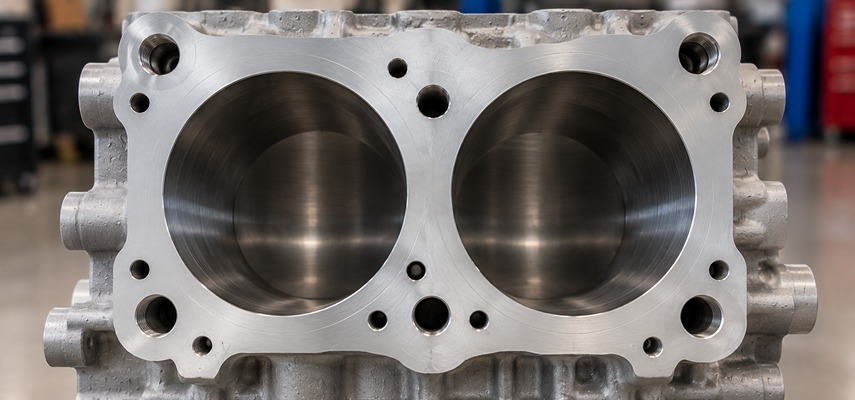

No, a factory Subaru engine block cannot be turned into a closed deck with bolt-on parts or a home shop job. IAG builds its closed deck blocks by machining new Subaru case halves on a CNC mill to accept closed deck inserts, so the practical route for an owner is to buy a finished closed deck short block, such as the IAG 750, 950, or 1150. Those three are rated for about 750, 950, and 1150 BHP, and they cost from about $5,500 to $9,500.
The question comes up constantly among owners planning a big power build. Someone has a healthy open deck engine, a plan for more boost, and a reasonable hope that the block can simply be strengthened. This guide explains what open and closed deck actually mean, why the conversion is not a DIY job, and what the realistic options are.
What Open Deck and Closed Deck Actually Mean
The deck is the top surface of the engine block where the cylinder head bolts on. In an open deck design, the cylinder walls stand free around their upper edge, with coolant flowing all the way around. A closed deck design bridges the gap between the cylinder wall and the outer block with material, which supports the top of the cylinder against flex under high pressure.
Terminology varies by source. Many describe the EJ25 in the WRX and STI as semi-closed deck, where partial webbing supports the cylinders, and others call factory Subaru blocks open deck, while the FA20 and FA24 are commonly described as open deck. The label matters less than the result, which is that a stock block has less cylinder support than a purpose-built closed deck one. Readers who want more depth can open what a closed deck engine is and why it matters, which covers the basics.
Why You Cannot Simply Convert Your Own Block
IAG describes how its closed deck blocks are made, and the process explains why a home conversion is off the table. It starts with brand new Subaru case halves, which are assembled and then machined on a CNC mill to accept its closed deck inserts, which transforms the block into a solid deck. The result is then bored and honed to its final size.
That is precision machining on assembled case halves, not a kit that bolts on. A used block that has already seen miles and heat adds more variables. For nearly every owner, the realistic route is to buy a block that was built closed deck from the start, instead of trying to convert the existing one.
Your Real Options
Owners with a high power goal usually choose from three paths. The first is to buy a closed deck short block, which is the cleanest solution and the one this guide focuses on. A second is cylinder sleeving, which engine builders use on other engines as another way to strengthen the cylinders, and a Subaru specialist can advise whether it suits a given build.
The third is to keep the factory block and keep power within its limits. That is a legitimate choice for most street cars. IAG’s own guidance says an unmodified semi-closed block can handle roughly 400 to 500 horsepower reliably, and that builds pushing toward 700 to 800 horsepower are where a closed deck becomes the only sensible route. Owners can see how this plays out in the reliable 400whp EJ257 build recipe.
IAG 750: The Entry Point for Closed Deck
The IAG 750 EJ25 Closed Deck Short Block is where IAG’s closed deck line begins. It uses a brand new EJ25 case that is converted to closed deck and bored and honed to 99.75 mm. IAG pairs it with a new nitride-treated 2017 and newer STI crankshaft and IAG-spec Tuff H-Beam connecting rods with ARP rod bolts.

At about $5,500, it is the least expensive closed deck block in the lineup, and IAG rates it at 750 BHP. It builds on IAG’s 550 block, which is a forged-internals build without the closed deck, and adds the proprietary closed deck system. The deeper breakdown lives in what the IAG 750 supports and who should build it.
IAG 950: A Step Up for Serious Boost
The IAG 950 EJ25 Closed Deck Short Block targets owners with bigger turbos and higher boost targets, with IAG rating it at 950 BHP. It sits at about $6,500, only a thousand dollars above the 750, so it is worth a look for anyone whose goals sit above the 750’s rating.

The sensible choice depends on the power target and the supporting parts around it. A block is only one piece, and the IAG 950 guide explains what that block supports and who should build it.
IAG 1150: For the Largest Power Goals
The IAG 1150 2.5L Closed Deck Short Block is the highest rated of the three, at 1150 BHP and about $9,500. It suits builds that are already well past what the 950 targets.

Few street cars need this much block, and the cost reflects it. Anyone weighing it should read whether the IAG 1150 is the right build for your goals, and how much power an IAG short block can handle to see where each rating fits. Owners who want a milder build can look at the IAG 550 short block, which skips the closed deck.
What About a 2015 or Newer WRX
The same question applies to the FA20 and FA24 WRX, whose factory blocks are commonly described as open deck. IAG builds closed deck short blocks for those engines as well, including an 800 BHP version for the 2015 to 2021 WRX and a 1000 BHP version for the 2022 to 2024 WRX. The EJ25 blocks above fit the WRX, STI, Legacy GT, and Forester XT, so owners of the newer cars should look at the FA-specific blocks instead.
Does Closed Deck Hurt Cooling
It is a fair concern, since closing the deck leaves less room for coolant around the top of the cylinders. Some builders warn about reduced cooling capacity, while others say a well-designed closed deck block keeps temperatures stable in practice. The tradeoff is real and tends to matter most on long, hot sessions, which makes the cooling system a bigger priority on any closed deck build.
A block also cannot rescue an engine from poor tuning, weak fueling, or detonation, since those problems break engines regardless of the deck design. The most common STI engine failures guide and the WRX version explain what usually goes wrong.
Short Block, Long Block, and What Else the Build Needs
A short block includes the block and rotating assembly. Long blocks add the cylinder heads, which changes the project and the budget, and short block versus long block lays out the difference. STI owners can use which EJ257 build level is right for you to match the block to a goal.
A strong block still needs strong support around it. Head studs, fueling, cooling, and tuning all matter, and why ARP head studs matter and supporting mods for big turbo builds cover the usual list. The full lineup lives on the IAG short block page, and owners comparing the engine families can read EJ207 versus EJ257.
Frequently Asked Questions
Can you make an open deck Subaru engine closed deck?
Not with bolt-on parts or at home. IAG machines new case halves on a CNC mill to accept closed deck inserts. The practical route for an owner is to buy a closed deck short block.
Is the WRX or STI engine open deck or closed deck?
Factory Subaru blocks are open deck or semi-closed deck, depending on the engine and the source. The EJ25 is commonly called semi-closed, and the FA20 and FA24 are commonly called open deck.
How much power can a stock Subaru block handle?
IAG’s guidance is that an unmodified semi-closed block can handle roughly 400 to 500 horsepower reliably. Builds aiming at 700 to 800 horsepower are where IAG says a closed deck becomes the only sensible route.
How much does a Subaru closed deck short block cost?
IAG’s EJ25 closed deck short blocks cost about $5,500 for the 750, about $6,500 for the 950, and about $9,500 for the 1150.
Does a closed deck block overheat?
Closing the deck leaves less coolant around the cylinder tops, so cooling deserves attention on any closed deck build. Many builders report stable temperatures with a well-designed block and a healthy cooling system.
Do I need a closed deck block for a stock-power WRX or STI?
No. A stock or mildly modified car does fine on the factory block. Closed deck becomes relevant once a build targets power well beyond the factory range.
0 Comments for “Can You Make an Open Deck Subaru Engine Closed Deck?”