
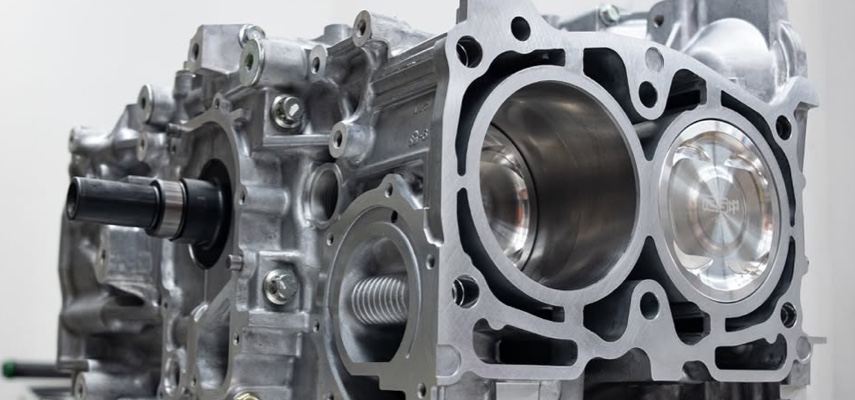

The factory EJ25 has a well-documented ceiling. Under sustained high boost, the stock pistons crack, the connecting rods bend, and ringland failure becomes a matter of when rather than if. For Subaru WRX and Subaru STI owners who have pushed past what the stock internals reliably support, the IAG 550 EJ25 Short Block replaces the factory weak points with forged internals built to handle sustained high-boost operation. It targets builds up to 550 BHP and is the most accessible tier in the IAG EJ25 short block lineup.
This post covers what the IAG 550 is built with, who it suits, and what the rest of the build needs to support it.
What the IAG 550 Is Built With
Every IAG 550 Short Block starts with brand-new Subaru OEM EJ25 case halves bored and honed to 99.75mm. The block retains the factory open-deck architecture. However, the internal components that fail under high boost are replaced entirely with forged performance alternatives.
Inside the assembly, IAG-spec H-Beam forged connecting rods replace the factory units. These are secured with ARP2000 rod bolts and paired with ACL or King race rod and main bearings. The H-Beam design handles higher RPM operation and increased engine loads more reliably than the factory cast rods. Factory rods are a known weak point on modified EJ25 builds, and replacing them is a core part of what makes the 550 a meaningful upgrade over a stock rebuild.
The pistons are IAG-spec JE forged units manufactured from 2618-T6 forged aluminum at 99.75mm. Factory EJ25 pistons use a hypereutectic cast design that cracks under detonation and elevated cylinder pressure. The JE forged pistons address this directly with thicker reinforced ringlands and an asymmetrical skirt design. The asymmetrical skirt reduces piston weight while maintaining stability and improving flame travel across the combustion chamber. Heavy-duty chromoly wrist pins and Tru-Arc locks complete the piston assembly.
The rotating assembly centers around a new Subaru nitride-treated STI crankshaft. Every IAG 550 ships fully assembled using 100% new components. There are no reused or reconditioned parts in the build.
Compression Ratios
The IAG 550 supports multiple compression ratio configurations. The right combination depends on the cylinder head and head gasket used. With EJ257 heads and an OEM head gasket the ratio is 8.8:1. With a 0.039″ JE ProSeal head gasket it drops to 8.5:1. EJ255 D-head configurations run 9.3:1 with an OEM gasket and 9.0:1 with the ProSeal. S20 head builds without combustion chamber modification run 9.4:1 OEM and 9.1:1 ProSeal. The fuel strategy and tuning approach for the specific build should guide the final decision.
Who the IAG 550 Is For
The IAG 550 suits WRX and STI owners who have outgrown the factory internals and need a stronger foundation for a street-focused build. The typical buyer runs or plans a moderately aggressive turbo setup, a professional tune, and supporting fuel system upgrades. They are not chasing four-digit horsepower. Instead, they want a reliable forged internal foundation that handles sustained boost at street power levels without the failure risk the stock pistons and rods carry past their limits.
Specifically, the 550 is the right choice for builds targeting 400 to 550 BHP where street reliability is the priority. Owners who have experienced ringland or rod failure and want to rebuild correctly the first time find the 550 the most logical step up from a stock block. Additionally, owners planning future power increases who want to build a stronger internal foundation now and tune to a higher level later find the 550 a practical starting point before stepping into the higher tier specifications.
At $3,999.99 it is the lowest-cost entry into the IAG EJ25 short block lineup. The H-Beam rod and JE piston specification provides a significant reliability improvement over the factory block without requiring the more expensive Tri-Beam rod and FSR piston specification of the higher tiers. For STI owners planning their build sequence, the STI performance upgrade guide covers how the short block fits into the broader build path. WRX owners can find the equivalent at the WRX performance upgrades hub.
How the IAG 550 Compares to the Tiers Above It
The IAG EJ25 lineup steps up through the 750, 950, and 1150 tiers. Each uses progressively stronger internal components and block construction targeting higher power ceilings. Understanding where the 550 sits helps clarify whether it is the right choice or whether a higher tier better matches the build goal.
The 750 is the first tier to include closed-deck block reinforcement, which stiffens the cylinder walls and addresses head gasket failure from cylinder wall flex under high boost. It also uses IAG-spec Tri-Beam forged connecting rods with ARP 625+ rod bolts and JE FSR pistons with a skirt coating, targeting builds up to 750 BHP. For owners whose power goals sit clearly above 550 BHP, or who are specifically concerned about head gasket reliability at elevated boost levels, the 750 is therefore the more appropriate foundation.
For builds that genuinely target 400 to 550 BHP on a street car where the priority is replacing the weak factory internals rather than a full block reinforcement, the 550 provides the right level of strength at a lower price point. The 950 and 1150 target builds approaching and exceeding four-digit horsepower using race-grade internal specifications suited for competition applications. A full comparison of all tiers is available at the IAG short block hub.
What the Build Needs to Support the IAG 550
A short block upgrade raises the ceiling on what the engine handles. However, the supporting systems need to match that ceiling. Installing the IAG 550 into a car with a stock turbo, stock fueling, and an off-the-shelf tune does not unlock 550 BHP. The build functions as a complete system, and each component needs to match the target power level.
Turbocharger
The stock WRX and STI turbochargers reach their airflow limits well below 550 BHP. A turbo upgrade capable of supporting the target power level is therefore part of the same build conversation as the short block. For WRX owners, the WRX turbo airflow upgrades hub covers the options at this power range. STI owners can find the equivalent at the STI turbo airflow upgrades hub.
Fuel System
At 400 to 550 BHP, the stock fuel system limits power delivery before the short block does. Upgraded injectors and a high-capacity fuel pump maintain safe air-fuel ratios at the power levels this build targets. The WRX fuel system upgrades hub and the STI fuel system upgrades hub cover the fueling components required at this level.
Head Studs and Head Gaskets
Because the IAG 550 retains the open-deck block architecture, head sealing becomes especially important at elevated boost levels. ARP head studs maintain clamping force more consistently than factory torque-to-yield bolts under thermal cycling and high cylinder pressure. The post on ARP head studs for WRX and STI covers which kit fits builds at this power level. For owners who are concerned about head gasket reliability at the top of the 550’s power range, stepping up to the IAG 750 with its closed-deck reinforcement is worth considering before committing to the build.
ECU Tuning
A professional custom tune is required after installing the IAG 550. The ECU needs calibration for the new compression ratio, the rotating assembly clearances, the turbo setup, and the fuel system changes. Running a stock or off-the-shelf map on a built engine causes damage. The tuner should have specific experience with high-power EJ platform builds to set appropriate targets for the new setup.
Oil System
Oil control becomes more critical as power increases. An upgraded oil pickup and oil pan baffle are standard additions at this build level. Additionally, an IAG air oil separator reduces oil vapor ingestion into the intake system, protecting both the turbo and the new short block internals over time. The post on whether an air oil separator is worth it on a WRX or STI covers why this upgrade belongs alongside any built engine.
Supporting Mods Overview
The full picture of what a built EJ25 requires beyond the block itself is covered in the post on supporting mods required for big turbo WRX builds. The core list applies directly to any 550 BHP EJ25 build: fueling, intercooling, turbo, head sealing, tuning, and oiling all need to match what the short block supports.
Common EJ25 Failure Modes the IAG 550 Addresses
The factory EJ25 fails in predictable ways as boost and power increase. Ringland failure is the most common. Factory hypereutectic cast pistons crack under detonation and elevated cylinder pressure. The forged JE pistons in the IAG 550 address this directly with thicker ringlands and a stronger alloy that absorbs combustion shock rather than cracking under it.
Connecting rod failure on hard-used or high-mileage stock blocks is the other primary failure mode the 550 addresses. The H-Beam forged rods handle sustained load at higher RPM more reliably than the factory cast units, which bend or break under the loads that a serious performance build generates. For a detailed look at why these failures happen and how to prevent them, the post on most common WRX engine failures covers each failure mode and the build decisions that prevent them.
Shop the IAG 550 EJ25 Short Block
The IAG 550 EJ25 Short Block ships in 1 to 2 weeks and is priced at $3,999.99.