
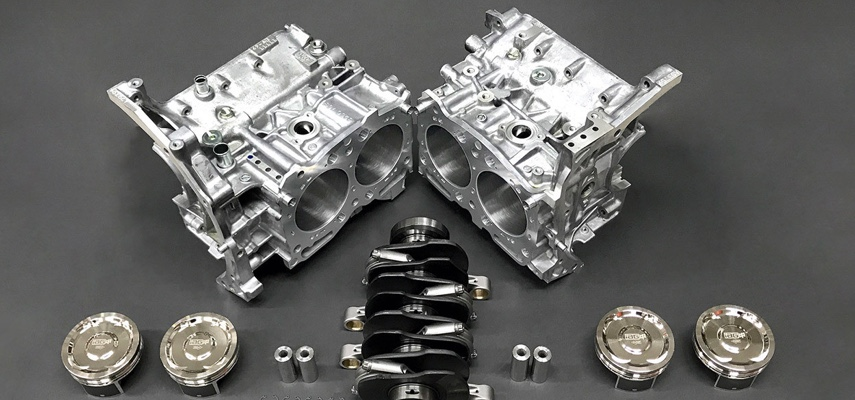

Closed deck is one of the most used terms in WRX and STI build conversations and one of the least explained. Most owners know it means a stronger engine. Few know exactly why. This guide gives Subaru WRX and Subaru STI owners a clear explanation of what closed deck construction actually means, why it matters, and when a closed deck short block becomes the right call for a build.
What Open Deck and Closed Deck Actually Mean
Every engine block has cylinders surrounded by a water jacket that circulates coolant. The deck is the top surface of the block where the cylinder head sits. The difference between open deck and closed deck is what happens at that deck surface around the cylinder bores.
An open deck block has gaps between the cylinder bores and the surrounding block structure at the top of the engine. The cylinder walls are not fully supported where they meet the deck. Coolant flows freely through those gaps, which works well for cooling at factory power levels. The trade-off is that the cylinder walls lack structural support at the point where cylinder pressure is highest.
A closed deck block has material bridging the cylinder bores at the top of the block. The cylinders are fully connected to the surrounding structure. Think of it like the difference between a table with gaps cut into the surface and a solid table. Under light load both hold up fine. Under heavy load the solid surface does not flex. The gaps in the open surface do.
Why the WRX and STI Stock Block Uses Open Deck Construction
Open deck blocks are cheaper and easier to manufacture. They cool more efficiently at stock power levels because coolant moves freely around the full cylinder circumference. For a car designed to operate at factory boost levels, open deck construction is an adequate engineering choice that keeps production costs reasonable.
The problem surfaces as boost and cylinder pressure increase. The unsupported cylinder walls flex under high pressure. That flex causes the head gasket interface to move, which leads to head gasket failures. It also causes cylinder bore distortion over time, which accelerates wear and eventually causes catastrophic engine failure. This is why the EJ257 in the STI has a well-documented reputation for head gasket failures at elevated power levels. Our post on most common WRX and STI engine failures covers where those failures typically start and what leads to them.
What Closed Deck Construction Actually Changes
The structural support that closed deck construction adds to the cylinder bores changes how the engine behaves under high cylinder pressure in four specific ways.
Cylinder wall rigidity increases significantly. The supported deck surface resists flexing under the pressure spikes that come with high boost and aggressive fueling. The cylinders hold their shape rather than distorting under load.
Head gasket reliability improves as a direct result. Less deck flex means less movement at the head gasket interface on every combustion event. The failure mechanism that kills open deck EJ engines at high power levels is dramatically reduced.
The power ceiling rises. Closed deck blocks sustain significantly higher cylinder pressures reliably because the structural integrity holds where an open deck block would begin to flex and fail. This is what allows IAG closed deck short blocks to support 950 and 1150 BHP respectively.
Cooling requires more attention. The trade-off for the added structural material is reduced coolant flow around the cylinders. At high power levels this makes a proper cooling system more important. Our WRX cooling mods guide covers what the cooling system needs to support a built engine reliably.
Open Deck vs Closed Deck: The Power Level Where It Matters
The open deck design is not a problem until it is. At stock and mild bolt-on power levels the stock block handles the load without issue. The risk starts to increase as power climbs.
At stock and mild builds up to around 350whp, the open deck block is adequate. The cylinder pressure stays within the range the factory design handles reliably. As power climbs into the 400 to 450whp range, especially on E85 with aggressive tuning, the open deck design starts to become the risk factor in the build. Sustained high boost on an open deck block at these power levels is where failures begin to happen with regularity.
At 450whp and above, closed deck construction is the right foundation. The stock block at sustained high power is not a question of if it will fail but when. Our post on how much power the stock FA20 can handle covers exactly where that ceiling sits on the WRX platform.
IAG Closed Deck Short Blocks for WRX and STI
IAG is the standard for closed deck short blocks on the Subaru platform. Their process converts the EJ block to a closed deck design through proprietary machining that adds material to bridge the cylinder bores. The result retains the EJ architecture but eliminates the structural weakness of the factory open deck design. Forged internals, tighter machining tolerances, and platform-specific engineering make the IAG closed deck block the foundation most serious WRX and STI builds are built around.
The 950 and 1150 designations refer to the BHP rating of each block. The 950 covers the majority of serious street and track builds. The 1150 is for competition builds pushing maximum power. Browse IAG closed deck short blocks for WRX and STI to compare both options. Our post on how much power an IAG short block can handle covers what each block supports in real-world whp terms. For STI owners planning a serious build around a closed deck foundation, the Subaru STI performance upgrade guide covers how the short block fits into the complete build picture.
When Do You Actually Need a Closed Deck Block
For a daily driver with modest power goals, a closed deck block is not needed. The stock open deck block handles bolt-on builds and moderate power increases without issue.
For a serious street build targeting 400 to 500whp, planning for a closed deck block makes sense. The stock block can handle that range in the short term but sustained operation at those power levels on E85 puts it at risk. Building the closed deck foundation early avoids an expensive mid-build failure.
For any build running E85 aggressively at 450whp and above, closed deck construction is the right foundation from the start. For track cars and competition builds, it is non-negotiable. The WRX engine build guide covers how to plan a built engine around a specific power goal. The WRX engine reliability guide covers how supporting modifications protect the engine at each stage of the build.
Build on the Right Foundation
Closed deck construction is not a luxury upgrade for extreme builds. It is the correct engineering solution for any WRX or STI build that is going to push past what the open deck stock block was designed to handle. The stock block is adequate until it is not — and when it fails at high power, the cost of rebuilding around a closed deck foundation from scratch far exceeds the cost of doing it right the first time.
Browse IAG short block options for WRX and STI to find the right foundation for your build.
0 Comments for “What Is a Closed Deck Engine and Why It Matters for Your WRX or STI”