
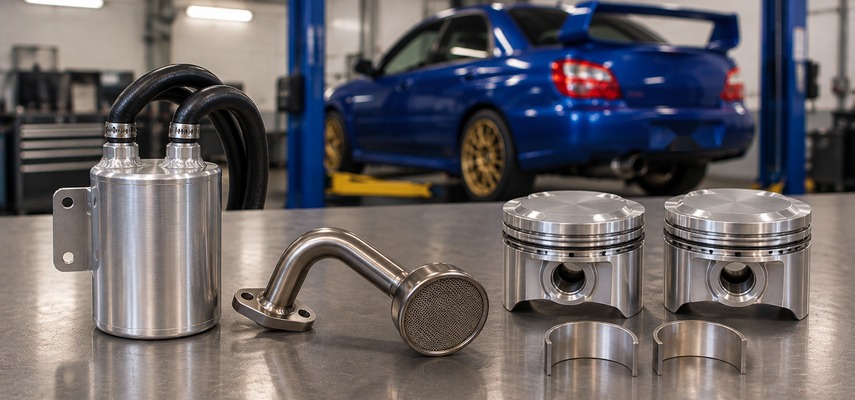

The Subaru EJ257 is the 2.5 liter turbocharged flat-four used in the US WRX STI from 2004 to 2021, with a 99.5 mm bore, a 79 mm stroke, and a listed compression ratio of 8.2:1. References list its output at about 293 to 300 hp in the earliest cars and 305 hp for most of its run, with torque of 290 to 300 lb-ft, and builders point to the piston ring lands and rod bearings as its weak points once power rises. On a stock tune with regular oil changes it is a dependable engine, and most of its reputation for failures comes from tuned and modified cars.
Wrench Masters sells and works on WRX and STI builds in St. Petersburg, FL, and the EJ257 is the engine behind most of them. This guide covers its specs by model year, what it makes, how it differs from the EJ255 and the JDM EJ207, and where its weak points sit, with a short list of parts that address them.
What Are the EJ257 Specs by Model Year?
| Model years | Chassis | Listed output | Valve timing | Notes |
|---|---|---|---|---|
| 2004 to 2007 | GD | About 293 to 300 hp, up to 300 lb-ft | Single AVCS on the intake cams | IHI VF39 turbo early, and one reference lists a VF43 around 2007 |
| 2008 to 2014 | GR and GV | 305 hp, 290 lb-ft | Dual AVCS on all four cams | IHI VF48 turbo, per 8020 Automotive |
| 2015 to 2021 | VA | 305 hp, 290 lb-ft | Dual AVCS | 310 hp is listed for the 2018 Type RA and some later cars, and 341 hp for the limited 2019 S209 |
Output figures differ slightly between references, especially for the 2004 to 2007 cars, which show up as both 293 and 300 hp depending on the source. The numbers above reflect what the references list, so treat them as ranges. Every EJ257 displaces 2,457 cc, uses DOHC with four valves per cylinder, and has a die-cast aluminum block.
How Much Power Does the EJ257 Make?
Most EJ257 cars sit at 305 hp and 290 lb-ft in stock form, with the earliest 2004 to 2007 cars listed a few horsepower lower or higher depending on the source. Those figures are crank ratings, and wheel numbers run lower after drivetrain loss. The post on how much power the stock STI turbo makes covers what the factory turbo supports, and what a stock EJ257 can handle covers where the factory hardware gives out.
What Is the Difference Between the EJ255 and the EJ257?
The EJ255 is the 2.5 liter turbo engine in the WRX of the same era, and the EJ257 is the STI engine. Both share the 99.5 mm bore and 79 mm stroke, and references describe them as similar in reliability and common problems. One engine reference says the EJ257 can handle more boost than the EJ255, which makes it the better starting point for heavy modification.
The JDM EJ207 is a different engine with a 2.0 liter displacement, and EJ207 versus EJ257 explains how the two compare. Owners curious about the newer engine can read EJ257 versus FA24.
Is the EJ257 Reliable?
The honest answer depends on how the engine is used. 8020 Automotive rates its reliability as below average, but not because of endless problems, since issues become far more common on tuned and modified engines. The weak points that builders name most often are consistent across sources, and they cluster in the pistons, the oiling, and the block.
Piston ring lands are the most cited weak point, and detonation is the usual cause. An engine builder quoted in Engine Builder magazine says the EJ257 comes with a forged crank and forged rods from the factory, but not forged pistons, and that a cracked ring land is the next failure after a spun rod bearing. MotoIQ reports that rod bearings can be starved of oil at high rpm, and Crawford Performance points to the open or semi-closed deck as a limit on head gasket sealing near 500 whp.
Sources disagree on how to label the deck, with some calling the block open deck and others semi-closed, so treat the label with caution. The practical point is the same either way, which is that a stock block offers less cylinder support than a purpose-built closed deck. For the difference, see what a closed deck engine is, and the most common STI engine failures guide covers each failure in detail.
Maintenance also matters. 8020 lists valve cover gaskets as the most common oil leak, and the engine references agree that regular oil changes are the single most important habit. Boost limits matter too, and how much boost is safe on a stock WRX or STI sets a baseline.
What Can You Do About the EJ257’s Weak Points?
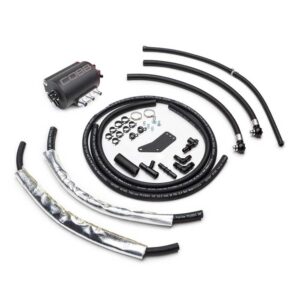
Oil control is the usual first step. Crawford Performance calls an air/oil separator essential on a built EJ257 to limit oil consumption and detonation, and COBB lists separators by generation. The 2004 to 2007 STI needs the 2004 to 2007 part, and the 2008 and newer STI needs the 2008 to 2020 part, so confirm the year before ordering.
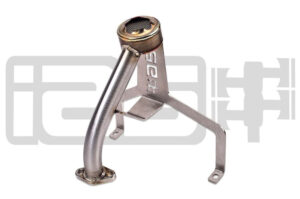
Oiling is the next place builders look, since oil starvation is the cause behind spun rod bearings. IAG lists a V2 oil pickup for the 2002 to 2020 WRX and STI as part of its oiling lineup, alongside a baffle and windage tray and oil pans.
When an engine needs a rebuild anyway, the bottom end is the place to fix the known weak points together. IAG’s 550 short block uses forged internals for street builds up to its 550 BHP rating, and the IAG 550 guide explains who it suits.

Do You Need a Tune After EJ257 Upgrades?
Oil control parts and a short block are bolt-on or rebuild items, but any engine making more power than stock needs a proper tune, and detonation is exactly what damages the ring lands. Check the emissions and CARB status of each part for your state before ordering, since rules vary, and ask the Wrench Masters team if a fitment or legality question comes up.
For the full picture of a built EJ257, which EJ257 build level is right for you maps the options, and short block versus long block explains the choice. A proven combination appears in the reliable 400whp EJ257 build recipe, and why ARP head studs matter covers the clamping side.
The supporting hubs are the STI engine reliability hub and the STI engine build and power goals hub. Full ranges appear on the IAG short block page, the IAG oil catch can page, and the Subaru STI parts page list the full range.
Frequently Asked Questions
What engine is in a Subaru WRX STI?
The US WRX STI from 2004 to 2021 uses the EJ257, a 2.5 liter turbocharged flat-four. Japan’s STI uses the 2.0 liter EJ207, which was never sold new in the US.
How much horsepower does the EJ257 make?
References list about 293 to 300 hp for the 2004 to 2007 cars and 305 hp for most 2008 to 2021 cars. The 2018 Type RA is listed at 310 hp, and the 2019 S209 at 341 hp.
Is the EJ257 a reliable engine?
On a stock tune with regular maintenance it is dependable. 8020 Automotive rates its reliability as below average overall, with problems concentrated on tuned and modified engines, mainly ring lands, rod bearings, and head gasket sealing.
What are the EJ257’s weak points?
Builders most often name the piston ring lands, the rod bearings under oil starvation, and the limited cylinder support of the stock block at high power. Valve cover gasket leaks are the most common oil leak.
What is the difference between the EJ255 and EJ257?
The EJ255 is the 2.5 liter turbo engine in the WRX, and the EJ257 is the STI version. Both use a 99.5 mm bore and 79 mm stroke, and one engine reference says the EJ257 can handle more boost.
Can you make an EJ257 closed deck?
Not with bolt-on parts. Closed deck blocks are built by machining new case halves, so the practical route is a finished closed deck short block, covered in the IAG short block guides linked above.
0 Comments for “Subaru EJ257 Engine: Specs, Power and Reliability”