
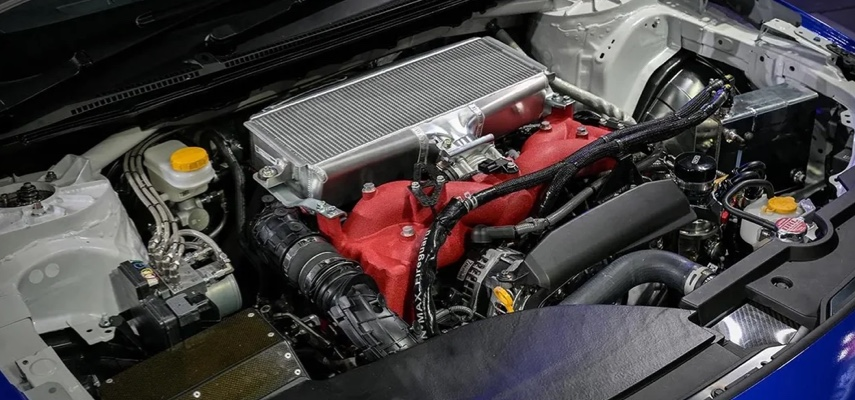
The EJ257 and FA24 are the two turbocharged Subaru engines most WRX and STI owners encounter when researching builds or considering a platform change. The EJ257 powers the Subaru STI through its entire USDM production run. The FA24 is the engine Subaru introduced in the 2022 and newer WRX. They are fundamentally different engines in architecture, displacement philosophy, and upgrade potential, and understanding those differences is essential before making any build decisions. This post covers what sets them apart, what each platform does well, and which one makes more sense depending on the build goal.
Where Each Engine Comes From
The EJ257 is a 2.5 liter naturally aspirated displacement turbocharged flat-four that Subaru developed for the USDM STI in 2004. It uses a traditional port injection system, an open-deck block architecture inherited from Subaru’s earlier EJ platform, and a long stroke design that prioritizes torque and low-end power delivery. The EJ257 has been in continuous production in essentially the same form for nearly two decades, which means the aftermarket ecosystem, the professional knowledge base, and the available upgrade parts are exceptionally well developed.
The FA24 is a 2.4 liter direct-injection turbocharged flat-four introduced in the 2022 WRX. It uses a semi-closed deck block architecture from the factory, a shorter stroke than the EJ257, a twin-scroll turbocharger, and a significantly more modern engine management system. The FA24 was designed to address the EJ257’s known weaknesses while also meeting current emissions and efficiency standards that the older platform could not achieve.
Block Architecture: Open Deck vs Closed Deck
This is the most significant structural difference between the two engines. The EJ257 uses an open-deck block design where the area around the cylinder bores is not fully supported by the block material. Under high cylinder pressure, the cylinder walls can flex slightly, which is the primary cause of the EJ257’s well-documented head gasket failure mode under sustained high boost.
The FA24 uses a semi-closed deck block from the factory, meaning the cylinder walls have significantly more support than the open-deck EJ257 but are not fully enclosed like a purpose-built closed-deck conversion. This reduces the cylinder wall flex that causes head gasket problems on the EJ257 and gives the FA24 meaningfully better structural integrity under elevated cylinder pressure without requiring aftermarket block reinforcement. For owners who have dealt with EJ257 head gasket failures or spent money on closed-deck short block upgrades, the FA24’s semi-closed deck architecture addresses this problem at the foundation level.
The practical implication is that the FA24 can handle more cylinder pressure before its block becomes a structural limiting factor than the stock EJ257 can. This is not a small difference. It is one of the core reasons the FA24 has a higher stock power ceiling than the EJ257 despite displacing 100cc less.
Displacement and Power Delivery
The EJ257 displaces 2.5 liters and produces 310 horsepower and 290 lb-ft of torque from the factory in USDM STI trim. The FA24 displaces 2.4 liters and produces 271 horsepower and 258 lb-ft of torque in the 2022 and newer WRX. On paper the EJ257 appears to have the power advantage, but the comparison is more nuanced than the numbers suggest.
The EJ257’s power comes from a combination of displacement and a relatively aggressive factory tune that pushes the open-deck block close to its comfortable limit. The FA24 is more conservatively tuned relative to its structural capability, which means it has significantly more headroom above its factory output than the EJ257 does. A stock FA24 with a tune and supporting modifications can reach power levels that a stock EJ257 cannot reliably sustain without internal upgrades.
The post on how much power the FA20 and FA24 can handle covers the FA24’s safe power ceiling in detail, including what modifications unlock that headroom without requiring internal engine work.
Turbocharger Differences
The EJ257 uses an IHI VF series single-scroll turbocharger that reaches its airflow limit in the 350 to 380 wheel horsepower range. Beyond that point, intake air temperatures rise sharply, boost becomes inconsistent, and the turbo is operating outside its efficient range. A turbo upgrade is a required step for any EJ257 build targeting power levels above this threshold.
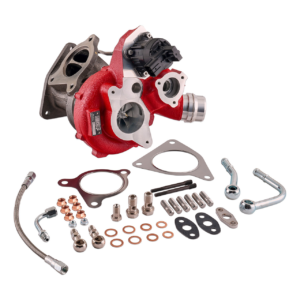
The FA24 uses a twin-scroll IHI turbocharger that is both more efficient and more capable than the EJ257’s unit. The twin-scroll design separates exhaust pulses between the two scroll paths, which reduces turbo lag, improves spool characteristics, and allows the turbo to operate more efficiently across a wider RPM range. The FA24’s stock turbo also supports more power than the EJ257’s unit before reaching its limit, which pushes the point at which a turbo upgrade becomes necessary further up the power curve.
For Subaru WRX FA24 owners looking to push past the stock turbo’s limits, the IAG 600 Ball Bearing Turbocharger is the purpose-built upgrade for the FA24F platform.
Upgrade Paths: EJ257 vs FA24
The EJ257 has the most developed aftermarket ecosystem of any Subaru engine. IAG’s closed-deck short block lineup covers the EJ257 from entry-level street builds through four-digit horsepower competition applications. The professional knowledge base for building, tuning, and maintaining the EJ257 is extensive, and the parts ecosystem is mature. For owners who want maximum upgrade flexibility and access to a deep pool of professional experience, the EJ257 platform delivers that.
The FA24’s aftermarket is newer but developing quickly. The semi-closed deck factory architecture means owners face less cylinder wall flex than EJ257 builders without requiring aftermarket block reinforcement as a baseline. The FA24 also benefits from direct injection, which improves fuel atomization and combustion efficiency compared to the EJ257’s port injection system. For owners building on the 2022 and newer WRX platform, the WRX turbo airflow upgrades hub covers the forced induction options available for the FA24.
For Subaru STI owners building on the EJ257, the STI engine build and power goals hub covers the full short block upgrade path. The STI turbo airflow upgrades hub covers the turbo side of the EJ257 build specifically.
Common Failure Modes Compared
The EJ257’s failure modes under high boost are well documented: ringland cracking from hypereutectic cast pistons, head gasket failure from open-deck cylinder wall flex, and connecting rod failure on high mileage or hard-used engines. These failures are predictable and the aftermarket has developed specific solutions for each one, from ARP head studs and Fire-Lock head gaskets for the sealing problem through IAG short blocks with forged internals for the piston and rod failures.
The FA24’s failure modes are less well established because the engine is newer, but the semi-closed deck architecture significantly reduces the cylinder wall flex problem compared to the EJ257. The factory forged crankshaft and revised piston design also address some of the EJ257’s known weaknesses from the outset. That said, the FA24 is not indestructible, and builds pushing significantly past the stock power level will eventually find the limits of the stock internals just as EJ257 builds do. The post on most common WRX engine failures covers the EJ platform failure modes in detail and provides context for understanding why the FA24’s architecture addresses them differently.
Which Engine to Build
The answer depends on which car the owner already has. An STI owner has an EJ257 and the decision is how to build it, not whether to swap it. The EJ257’s mature aftermarket and deep professional knowledge base make it one of the most well-supported performance engines available for modification, and the IAG short block lineup provides a clear upgrade path from street reliability through competition builds. The post on the IAG short block options for Subaru STI covers how to match the build level to the power goal.
A 2022 and newer WRX owner has an FA24 and benefits from the semi-closed deck factory architecture, the more efficient twin-scroll turbo, and the modern engine management system. The FA24’s higher stock power ceiling and structural headroom make it a strong foundation for builds in the 400 to 500 horsepower range without requiring the block reinforcement that EJ257 builds need at the same power level. The post on how much power an IAG short block can handle covers what the build path looks like once the factory internals become the limiting factor on either platform.


0 Comments for “EJ257 vs FA24: What Subaru Owners Should Know”