Both of these pumps show up constantly in fuel system upgrade conversations for the WRX and STI, and it is easy to assume the choice just comes down to picking whichever one flows more. The reality is these two pumps solve different problems and fit different builds, and picking based on flow numbers alone can lead to the wrong choice for a specific setup. This post breaks down what actually separates them, which one fits which kind of build, and what the decision costs either way.
The Core Difference: In-Tank vs External
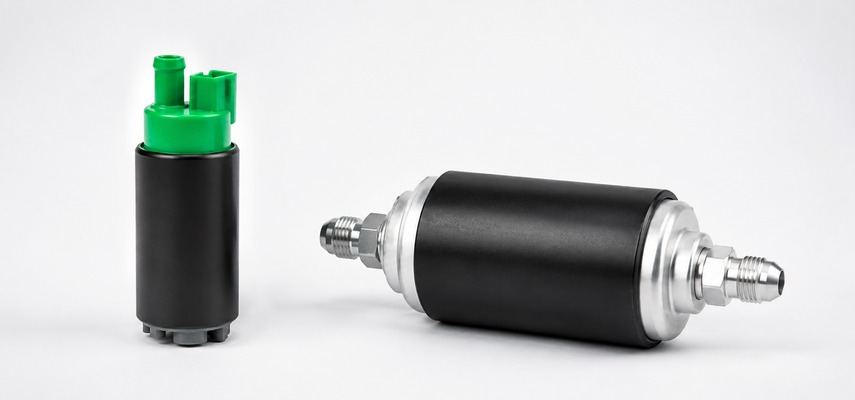
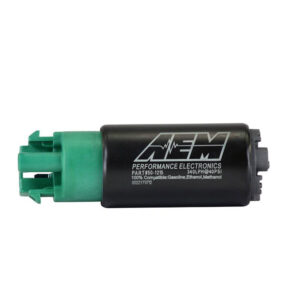
The single biggest difference between these two pumps has nothing to do with flow rate. The AEM 340LPH 65mm pump is an in-tank unit, designed to replace the factory pump inside the fuel tank using mounting hooks built for tight tolerance applications. The AEM 380LPH inline pump is an external unit, mounted outside the tank, typically near the firewall, using standard AN fittings for the inlet and outlet.
That distinction drives almost every other decision between the two. An in-tank pump keeps the fuel system looking close to stock from the outside, with no visible plumbing changes outside the tank itself. An external pump requires more involved mounting and line routing, but it also allows for easier future upgrades or servicing without pulling the tank apart again.
Why This Comparison Gets Oversimplified
It is common to see these two pumps compared purely on their rated flow numbers, as if a higher number always means a better choice. That framing skips over the actual engineering tradeoff between the two designs. An in-tank pump benefits from being submerged in fuel, which helps with cooling and noise, while an external pump runs outside that environment and depends more heavily on proper mounting and line design to perform reliably. Neither design is inherently superior, they are simply optimized for different priorities, and the flow number alone does not capture which priorities matter for a specific build.
Flow Capacity and Where It Actually Matters
On paper, the 380LPH inline pump flows more than the 340LPH in-tank unit, but the practical difference matters less than the raw numbers suggest for most builds. The 340LPH pump comfortably supports the fuel demand of the large majority of WRX and STI builds running bolt-ons, a moderate turbo upgrade, or E85 on a reasonably sized turbo. The 380LPH pump becomes the more relevant choice once a build pushes into bigger turbo territory or stacks E85 with aggressive boost targets, where the additional flow headroom actually gets used rather than sitting unused.
Buying more flow capacity than a build needs is not free. It is simply a more involved install for a benefit that will not show up until the rest of the build catches up to it.
Installation Complexity
The in-tank 340LPH pump requires accessing the tank and sending unit assembly, which on most WRX and STI platforms means working through the trunk or rear seat area rather than dropping the entire tank. It is a more contained job overall, even accounting for the fitment verification this pump specifically requires since it is built to a universal rather than vehicle-specific spec.
The external 380LPH pump requires finding a suitable mounting location, typically near the firewall, along with running AN lines to the pump’s inlet and outlet. This is a more involved install from a fabrication standpoint, but it also keeps the pump accessible for future service without needing to open the tank again.
Noise and Heat Considerations
In-tank pumps benefit from being surrounded by fuel, which naturally dampens pump noise and helps carry heat away from the pump motor. External pumps lose that advantage, running exposed to ambient engine bay temperatures and without fuel directly cooling the housing. In practice, this means an external pump setup needs more attention to mounting location, keeping it away from major heat sources under the hood, and ensuring adequate airflow around the pump body. It is a manageable consideration rather than a major drawback, but it is part of why external pump installs tend to require more planning than simply bolting the pump into place.
Wiring Requirements for Both
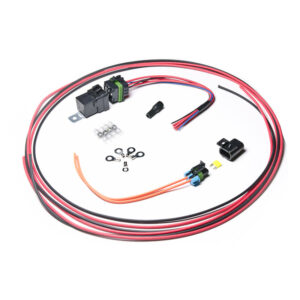
Neither of these pumps should run through factory wiring built for the stock pump’s lower current draw. Both benefit from a dedicated relay and fuse circuit sized for their actual draw, covered in the post on the DIY fuel pump wiring kit for WRX and STI. This is not a difference between the two pumps, it applies equally to both, but it is worth factoring into the total install scope regardless of which one gets chosen.
Price and Value Considerations
The 340LPH in-tank pump carries a lower price point and, for most builds, a simpler overall install when factoring in mounting and line routing. The 380LPH inline pump costs more and demands more installation work, but that additional cost buys headroom that specifically matters once a build’s fuel demand actually requires it. Paying for headroom a build will not use for years, if ever, is a reasonable choice for someone planning a long term power progression, but it is not the more cost effective choice for a build that is unlikely to need it.
Making the Actual Decision
The practical way to decide comes down to two questions. First, what is the realistic power and fuel type target for this build over its lifetime, not just where it sits today. Second, how much value does keeping the fuel system contained inside the tank actually hold compared to having an external, more serviceable pump. Builds with a clear, moderate power ceiling and a preference for simplicity tend to fit the 340LPH pump well. Builds planning to chase bigger power over time, particularly on E85, tend to be better served starting with the 380LPH pump rather than needing to revisit the decision later.
The WRX fuel system upgrades hub and STI fuel system upgrades hub both cover how pump choice fits alongside rails, lines, and regulator decisions for a complete fuel system build.
Frequently Asked Questions
Can I upgrade from the 340LPH pump to the 380LPH pump later if my power goals change?
Yes, though it means revisiting the tank to remove the in-tank pump and adding an external mounting location and line routing for the new pump. Starting with the pump that matches a realistic long term goal avoids that extra work down the line.
Does the 380LPH pump always outperform the 340LPH pump in practice?
Only when a build actually needs the additional flow. For moderate builds, the 340LPH pump delivers everything the fuel system needs, and the extra capacity of the 380LPH pump goes unused.
Do both pumps require the same wiring setup?
Both require a dedicated relay and fuse circuit sized for their current draw rather than running through factory wiring. Neither pump differs meaningfully from the other on this requirement.
Which pump is better for an E85 build?
It depends on the boost target alongside the E85 switch. A moderately boosted E85 build often fits within the 340LPH pump’s capacity, while a build combining E85 with aggressive boost typically benefits from the additional headroom the 380LPH pump provides.
Is one pump more reliable than the other long term?
Both are built for high performance use, and reliability comes down more to correct installation and wiring than to the pump design itself. An in-tank pump benefits from fuel cooling, while an external pump depends more on mounting location and airflow, so reliability in either case hinges on getting those install details right.