
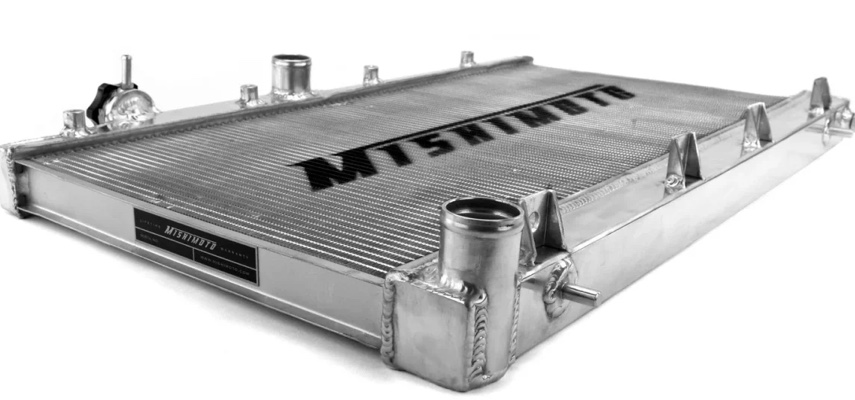

The 2015 to 2021 Subaru WRX runs a plastic end tank radiator from the factory. Under normal driving conditions it keeps coolant temperatures within range, but its thermal capacity becomes a limiting factor as engine load increases. A modified WRX running more boost, a WRX driven in hot climates, or a WRX that sees regular track use all place more heat into the cooling system than the factory radiator was designed to manage consistently. The Mishimoto Performance Aluminum Radiator for Subaru WRX 2015 to 2021 is a direct-fit upgrade that increases cooling capacity without requiring any modification to the car.
This post covers what changes with the Mishimoto radiator, how it differs from the factory unit, and when the upgrade makes sense for a WRX owner.
What Changes With the FA20 Platform in 2015
The 2015 WRX introduced the FA20DIT engine, which replaced the EJ series that had powered WRX models since the platform’s early days. The FA20DIT is a direct-injection turbocharged four-cylinder with a different thermal profile than the EJ. It runs higher combustion temperatures by design, and the cooling system on the 2015 and newer WRX is engineered specifically for this engine rather than being carried over from the previous generation.
This matters because radiator upgrades for the 2008 to 2014 WRX are not direct-fit on the 2015 and newer platform. The Mishimoto MMRAD-WRX-15 is engineered specifically for the FA20DIT WRX, matching the factory dimensions and mounting geometry of the 2015 to 2021 chassis rather than the previous generation.
What the Mishimoto Radiator Does
The Mishimoto Performance Aluminum Radiator replaces the factory plastic end tank radiator with a full aluminum unit featuring a high-efficiency core. Aluminum conducts heat more effectively than the plastic end tanks used in the factory unit, which improves how quickly heat transfers from the coolant into the air passing through the radiator. The increased core surface area also moves more coolant through a larger thermal exchange zone, which gives the system more capacity to shed heat during high-load driving.
The radiator includes a Mishimoto 1.3 bar high-pressure radiator cap. Running a higher pressure cap raises the boiling point of the coolant, which gives the system additional headroom before reaching a temperature where boiling becomes a concern. Combined with the improved core, the result is a cooling system that handles sustained load with more margin than the factory setup provides.
Every Mishimoto radiator comes backed by the Mishimoto Lifetime Warranty, including accident protection. That coverage is a meaningful differentiator from budget aluminum radiators that carry limited or no warranty terms.
Direct-Fit Installation
The Mishimoto radiator matches factory dimensions and mounting points exactly. It installs into the same location as the stock unit using existing hardware and is compatible with the factory fans and shrouds. No cutting, fabrication, or modification to surrounding components is required. For WRX owners who want a straightforward cooling upgrade without complexity, this is one of the cleaner bolt-on improvements available for the FA20 platform.
When This Upgrade Makes Sense
For a stock WRX driven primarily on the street in moderate temperatures, the factory radiator is generally adequate. The case for the Mishimoto upgrade strengthens as one or more of the following conditions apply to the specific car and how it is used.
Hot climate driving is the most common driver. Ambient temperature directly affects how efficiently a radiator sheds heat, since the temperature difference between the coolant and the surrounding air is what drives heat transfer. In consistently hot regions, the factory radiator operates closer to its limit during normal driving, and the additional capacity of the Mishimoto unit provides a buffer that keeps temperatures more stable. For WRX owners in Florida and similar climates, this is a practical daily driving upgrade rather than a track-only modification.
Increased power output is the second driver. As boost climbs through turbo upgrades, tuning, or supporting modifications, the engine produces more heat as a byproduct. A cooling system sized for stock output starts to show its limits as power increases. For WRX owners working through a build sequence, the post on WRX cooling mods: radiator vs intercooler vs oil cooler covers how the radiator fits alongside other thermal management upgrades as the build progresses.
Track use introduces the third scenario. Sustained high-RPM driving generates significantly more heat than street use, and the factory radiator’s thermal margin shrinks quickly during longer sessions. Owners who attend HPDE events or autocross regularly often see coolant temperatures climb toward the end of a session, even on otherwise stock cars. The Mishimoto radiator’s increased capacity gives the system more room before that becomes a concern. The WRX performance upgrades hub covers how cooling fits within the broader build sequence.
Radiator vs Intercooler: Which Comes First
WRX owners on a modified build sometimes ask whether the radiator or the intercooler should be addressed first. The answer depends on what the car is actually experiencing. The intercooler manages charge air temperature between the turbo and the intake manifold, while the radiator manages coolant temperature. They address different parts of the thermal picture and are not direct substitutes for each other.
If the car is experiencing boost-related power loss or heat soak on a warm day, the intercooler is likely the more pressing upgrade. If coolant temperatures are climbing under sustained load or in hot conditions, the radiator is the more relevant fix. Many WRX owners end up addressing both as the build matures, since a modified engine generates more heat across the board. The intercooler kits category covers the intercooler side of that conversation.
What to Pair With This Upgrade
A radiator replacement is a natural opportunity to address related cooling components in the same job, since the system is already being opened up. Cooling hoses on higher-mileage WRX models are commonly replaced alongside the radiator, since the labor overlap makes it cost-effective to do both at once rather than revisiting the cooling system a second time later. The cooling hoses category covers compatible options for the WRX platform.
For WRX owners also addressing oil temperature, particularly on track-driven or high-power builds, an oil cooler complements the radiator upgrade by managing a different part of the thermal system. The oil coolers category covers options that pair well with a radiator upgrade as part of a complete cooling system refresh.
Fan and shroud performance also contributes to how effectively the radiator sheds heat during low-speed driving and stop-and-go traffic where airflow from vehicle movement is minimal. The fans and shrouds category covers compatible upgrades for the WRX platform.
How This Differs From the Mishimoto WRX and STI 2008 to 2018 Radiator
Wrench Masters also carries the Mishimoto radiator for the 2008 to 2018 WRX and STI, which fits the previous generation EJ platform. That radiator covers the 2008 to 2014 WRX and the 2008 to 2021 STI. The MMRAD-WRX-15 covered in this post fits the 2015 to 2021 FA20 WRX only and is not interchangeable with the older platform fitment. Confirming the correct year and platform before ordering avoids a return.
Shop the Mishimoto Aluminum Radiator for WRX 2015 to 2021
The Mishimoto Performance Aluminum Radiator for Subaru WRX 2015 to 2021 is in stock and ships in 24 to 48 hours. Priced at $443.95 and backed by the Mishimoto Lifetime Warranty with accident protection.
Shop the Mishimoto Aluminum Radiator for Subaru WRX 2015 to 2021
0 Comments for “Mishimoto Aluminum Radiator for Subaru WRX 2015 and Up: What Changes and When to Upgrade”