
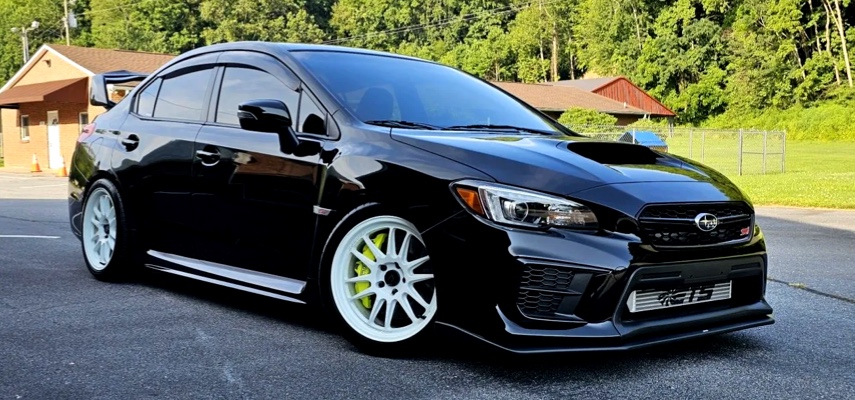

The most common WRX and STI build mistake is buying mods in the wrong order. A tune without supporting mods. A big turbo on a stock block. An exhaust before the fueling is sorted. The order matters as much as the parts themselves. This guide gives Subaru WRX and Subaru STI owners a real framework for planning a build, sequencing the mods correctly, and understanding what each stage actually costs. The WRX performance upgrades guide covers the full upgrade landscape if you want a broader starting point.
Start With a Power Goal
Before buying anything, establish a power goal. Everything else flows from that number. A 350whp street build needs a completely different sequence than a 600whp track build. The power goal determines the budget, the mod sequence, and whether the stock engine can survive the build.
Three tiers cover most WRX and STI builds. A street build targeting 300 to 450whp stays on the stock block with bolt-ons, an upgraded turbo, and a proper tune. A serious street or track build targeting 450 to 600whp requires a built bottom end, big turbo, and full supporting mods. A competition build pushing past 600whp is a purpose-built engine with standalone management and a budget to match.
Pick a tier before spending money. Buying Stage 1 parts with a Stage 3 power goal wastes money twice — once on parts that will need to be replaced and again on the parts they should have been in the first place.
Stage 1: Bolt-On Mods (Budget: $1,500 to $3,500)
Every WRX and STI build starts here. Bolt-on mods work on the stock engine without requiring major supporting modifications. The gains are real, the risk is low, and each mod builds on the last.
The COBB Accessport is the first purchase for any build. It loads a tune that unlocks what the factory ECU is holding back and ties every other mod together. An intake upgrade improves airflow to the turbo and pairs directly with the Accessport tune. A catback exhaust reduces backpressure and improves sound. Engine mounts reduce drivetrain movement before torque increases stress the chassis. Browse WRX bolt-on upgrades for a full overview of what fits at this stage, or check the best bolt-on mods for the FA20 WRX for specific recommendations.
The COBB Accessport for WRX is the starting point. Browse WRX intake upgrades and the WRX exhaust upgrades hub to see what is available for your platform.
Stage 2: Turbo and Airflow Upgrades (Budget: $3,000 to $8,000)
Stage 2 is where the power gets real. The bolt-ons are in place, the tune is dialed, and the stock turbo becomes the ceiling. An upgraded turbo paired with a matching intercooler, downpipe, and supporting fueling is what moves the car from a bolt-on build into genuine performance territory.
The intercooler needs to match the turbo. A top mount upgrade handles most street builds. A front mount is the call for big turbo setups pushing 450whp and above. Fueling — injectors and fuel pump — needs to keep up with what the turbo can push. A pro tune on the new combination is non-negotiable. Browse WRX turbo and airflow upgrades to compare options, and explore intercooler kits for WRX to find the right setup for the power level.
The supporting mods for big turbo WRX builds post covers the full checklist for this stage. The fuel pumps vs injectors guide breaks down which fueling upgrade matters most depending on the power target.
For 2022 and newer WRX owners on the FA24F platform, the IAG 600 Ball Bearing Turbocharger for 2022+ WRX FA24F is now available as the most complete bolt-on turbo kit for that platform.
Stage 3: Built Engine (Budget: $8,000 to $20,000+)
Stage 3 is where the stock block gets replaced. On the WRX, the FA20 has a power ceiling that a big turbo and E85 will push past. On the STI, the open-deck EJ257 reaches its limit sooner. A built short block is the foundation for anything beyond 500whp on a build that is going to be used hard.
The IAG short blocks for WRX and STI are the standard choice for the platform — closed-deck construction, forged internals, and platform-specific engineering. The WRX engine build guide covers how to plan a built engine around a specific power goal.
At this stage, the drivetrain needs to match the engine. A performance clutch handles the increased torque. Transmission mounts for WRX and STI keep the drivetrain stable under the added load. Clutch upgrades for WRX and STI cover what stage and brand make sense for the power level.
The Mod Sequence That Actually Makes Sense
The sequence matters as much as the parts. Building in the right order protects the engine at every stage and makes each mod more effective than the one before it.
Start with the Accessport. Every mod after it benefits from a tune. Add intake and exhaust together — they work as a system for airflow. Upgrade engine mounts before power increases stress the drivetrain. Step up to a turbo and intercooler sized to the power goal. Sort fueling to match what the turbo demands. Upgrade the clutch and transmission mounts before the drivetrain takes the full load of the new power level. Replace the short block when the build outgrows the stock engine.
Following this sequence means the car is always properly supported at each power level. Skipping steps creates weak points that fail under load. The WRX engine reliability guide covers how supporting modifications protect the engine long term. Solid engine mounts for WRX and STI are one of the most overlooked early upgrades on any build.
WRX vs STI: Does the Build Change?
The build stages are the same. The timing within each stage is different.
The Subaru WRX on the FA20 platform has more headroom on bolt-ons before the build hits a hard limit. The FA20’s weak point is the connecting rods. Under sustained high boost they bend or break before the block itself becomes the issue. Fueling keeps up reasonably well at moderate power levels, which gives the FA20 more runway on bolt-ons before a full supporting mod overhaul is required. Our FA20 vs FA24 guide covers the differences between WRX generations in more detail.
The Subaru STI on the EJ257 hits the fuel system limit first. The STI runs a completely different fueling architecture than the FA20 WRX and the stock fuel system becomes the restriction point before the block does. Once fueling is addressed, the open-deck EJ257 becomes the next weak point. The pistons are typically what give out under high cylinder pressure on a pushed EJ257. Planning for both the fuel system upgrade and the short block conversation earlier in the STI build avoids two expensive surprises instead of one.