
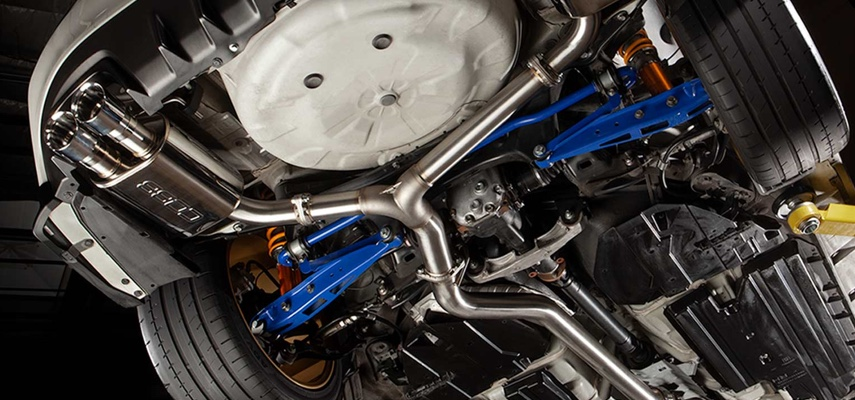

Not all exhaust upgrades deliver the same results on a WRX. A catback sounds different from a downpipe, and a turboback is a different conversation entirely. Understanding what each option actually does helps you spend money in the right place for your build stage.
This breakdown is for Subaru WRX owners who want a clear answer before committing to an exhaust upgrade.
How the WRX Exhaust System Works
Exhaust gases leave the engine, pass through the turbocharger, and then travel through the downpipe, the midpipe, and finally the muffler before exiting at the tip. Each section of that path represents a potential restriction. The closer the restriction sits to the turbo, the more it affects power. That is the core reason downpipes, catbacks, and turbobacks deliver different results. For a full picture of how exhaust fits into the WRX build, the WRX exhaust upgrades guide covers the complete system.
What a Downpipe Actually Does
The downpipe connects the turbocharger outlet to the rest of the exhaust system. It is the first major restriction point after the turbo, and on a turbocharged platform like the WRX, it has a bigger impact on power than any other single exhaust component.
Factory downpipes flow conservatively. An aftermarket unit with a larger diameter and a high-flow catalyst opens up that restriction and lets the turbo spool faster and build boost more efficiently. On a properly tuned WRX, a downpipe upgrade delivers a noticeable improvement in power and throttle response across the rev range.
Catted versus catless is the main decision here. A high-flow catted downpipe keeps the car street legal and still flows significantly better than stock. A catless unit flows more but removes emissions equipment entirely. For most street builds, a high-flow catted downpipe is the right call. Since the downpipe and turbo work so closely together, the turbo upgrade guide for WRX and STI is worth reading alongside this one.
What a Catback Exhaust Does
A catback replaces everything from the catalytic converter back. It improves exhaust flow, reduces backpressure, and changes the sound character of the car. On its own, the power gain is modest compared to a downpipe. Where a catback earns its place is in the combination — paired with a downpipe and a tune, it contributes meaningfully to the overall exhaust system performance. For a full breakdown on choosing the right catback for your WRX, the catback exhaust guide for WRX and STI covers everything in detail.
What a Turboback Exhaust Does
A turboback replaces the entire exhaust system from the turbo outlet to the tip. It combines the downpipe and catback into a single matched system, and it delivers the most power of the three options when paired with a proper tune.
The trade-off is that a turboback is not a simple bolt-on upgrade. It requires a tune to run correctly and safely. On a stock or lightly modified WRX, the gains from a turboback over a standalone downpipe and catback combination are real but not dramatic. Where a turboback makes the most sense is on a build that already has a larger turbo, upgraded fueling, and a tune ready to support it.
Which One Actually Makes More Power on a WRX
The downpipe delivers the biggest single power gain of the three options on a turbocharged platform. It addresses the primary restriction point in the system and directly affects how the turbo performs. If you can only do one exhaust upgrade, the downpipe is the one that moves the needle most.
A catback on its own adds modest power but improves sound and flow throughout the system. It pairs well with a downpipe and becomes more valuable as part of a complete setup rather than a standalone upgrade.
A turboback delivers the most total power but only when the rest of the build supports it. A tune is not optional with a turboback, and if you are still on stock internals, understanding how much boost is safe on a stock WRX is a useful reference before going that route.
Which Exhaust Upgrade Fits Your Build Stage
Build stage matters as much as which option delivers the most peak power.
On an early or mostly stock build, a catback is a low-risk first step. It improves the sound, adds some flow, and does not require a tune. When the tune is ready, the downpipe becomes the priority upgrade.
On a mid-stage build with a tune already in place, the downpipe is the move. It unlocks the most power for the money and pairs cleanly with the catback if one is already installed.
On a big turbo build, a turboback sized to match the turbo is the logical choice. The entire system needs to flow at a level that matches what the turbo can push. Our post on turbo upgrades for WRX covers how to match the right turbo to the right build. And since both downpipe and turboback upgrades require a proper tune to deliver their full benefit, our breakdown of what EFI tuning does for your WRX is worth reading before pulling the trigger on either.
Find the Right Exhaust Upgrade for Your WRX
Downpipe, catback, and turboback all have their place depending on where the build is and where it is headed. The downpipe moves the needle most on a turbocharged platform. The catback adds flow and sound. The turboback ties it all together on a build that can support it.
As power increases, the rest of the drivetrain needs to keep up. Solid engine mounts for WRX and STI reduce stress on the block and keep the drivetrain stable when torque increases alongside the exhaust upgrades.
Browse the full range of exhaust upgrades for WRX and find the right setup for your build stage and power goals.
0 Comments for “Downpipe vs Catback vs Turboback: What Makes Power on a WRX”