The factory turbocharger on the Subaru STI is a capable unit for stock and mildly modified builds, but it has a ceiling. As boost targets increase and power goals climb past what the factory turbo can support, the turbocharger becomes the primary restriction in the forced induction system. Choosing the right upgrade for the EJ257 platform means matching the turbo to the power goal, the supporting modifications, and how the car is actually used. This post covers the two STI turbo upgrades available at Wrench Masters, where each one fits in a build, and what the rest of the system needs to support them.
For context on when the stock turbo actually reaches its limit and what changes when upgrading, the post on stock turbo vs upgraded turbo on WRX and STI covers the decision in detail.
Understanding the EJ257 Turbo Platform
The EJ257 uses an IHI VF-series turbocharger from the factory, sized for responsive spool and moderate boost levels within the constraints of the open-deck block architecture. The factory tune runs conservative boost targets to protect the engine, and even with an Accessport and a stage tune, the stock turbo approaches its airflow limit in the 350 to 380 horsepower range depending on the supporting modifications in place.
Beyond that point, the turbocharger itself becomes the restriction. Adding more fueling, a bigger intercooler, or a more aggressive tune does not meaningfully change peak power output when the turbo cannot flow enough air to match those modifications. That is the inflection point where a turbo upgrade becomes the right next step rather than continuing to optimize around a factory unit that has reached its limit.
The EJ257’s open-deck architecture is also worth keeping in mind when planning a turbo upgrade. A larger turbo capable of producing 450 to 500 horsepower places more load on the engine internals than the factory block was designed to handle long term. For owners whose power goals push into this range, the post on IAG short block options for Subaru STI covers when a built bottom end becomes part of the conversation alongside the turbo upgrade.
Boost Lab TD06SL2-20G: The Street-Focused STI Upgrade
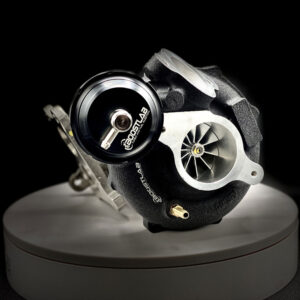
The Boost Lab TD06SL2-20G Turbocharger for Subaru STI is positioned as the OEM-style upgrade for STI builds targeting 450 horsepower. It uses an 8CM² fast low-end response turbine housing, which prioritizes spool characteristics and midrange power delivery over maximum top-end flow. For a street-driven STI where boost onset and drivability matter as much as peak power, the 20G delivers a meaningful step up from the factory turbo without the spool lag that comes with larger compressor wheels.
The 20G fits 2004 to 2018 Subaru WRX STI EJ25 applications and is available with an optional billet compressor wheel upgrade for an additional $350, which improves compressor efficiency and durability at sustained high boost. For most street builds targeting 400 to 450 horsepower, the standard 20G spec is appropriate. The billet upgrade makes more sense for owners planning track use or sustained high boost operation where compressor wheel longevity becomes a factor.
The 20G is the right starting point for STI owners who have addressed bolt-on modifications and supporting upgrades and are ready for a turbo that actually changes the power ceiling rather than refining what the stock unit already does. The reliable 400 horsepower EJ257 STI build post covers what a complete build around this turbo looks like, including fueling, intercooling, and tuning.
Boost Lab TD06SL2-54X: The High-Power STI Option
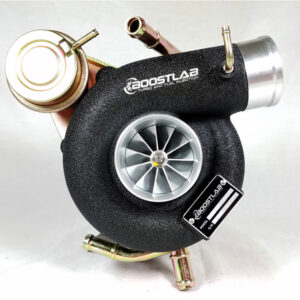
The Boost Lab TD06SL2-54X Turbocharger for Subaru STI steps up to a 54mm billet compressor wheel with extended exducer technology, targeting builds up to 500 horsepower. The larger compressor wheel moves significantly more air at peak output than the 20G, which opens up the top end of the power band for builds running E85, aggressive boost targets, and a fully built EJ257. For dedicated track builds or high-power street setups where peak output matters more than the very sharpest low-RPM response, the 54X is the appropriate upgrade.
The 54X also fits 2004 to 2018 Subaru WRX STI EJ25 applications and uses the same 8CM² turbine housing as the 20G. The difference is entirely in the compressor side, where the larger 54mm wheel with extended exducer provides meaningfully more top-end airflow capacity. Owners who are choosing between the 20G and the 54X should anchor the decision on their actual power target: if the goal is 400 to 450 horsepower on a street car, the 20G is the better fit. If the goal is 500 horsepower or more on a built engine running E85, the 54X provides the airflow headroom that target requires.
The dedicated post on the Boost Lab TD06SL2-54X for Subaru STI covers the full spec breakdown, what the build needs to support it, and who should run it.
What to Budget for an STI Turbo Upgrade
The turbo itself is one part of the total cost of a turbo upgrade on the STI. The full budget needs to account for the supporting modifications that a larger turbo requires to operate safely and deliver its rated power. Running a 450 to 500 horsepower turbo on a car with stock fueling, a stock intercooler, and an off-the-shelf tune does not produce 450 to 500 horsepower. It produces an unsafe build that cannot take advantage of the turbo’s airflow capacity.
The supporting modification list for a serious STI turbo upgrade includes an upgraded intercooler, a high-capacity fuel pump and matched injectors, ARP head studs to maintain head sealing under elevated cylinder pressure, and a professional custom tune calibrated specifically for the new turbo and fuel setup. For builds targeting 500 horsepower on E85, a built short block is also part of the budget rather than an optional addition. The post on supporting mods required for big turbo WRX builds covers the complete list and helps frame the full budget picture before committing to a turbo upgrade.
Where Turbo Upgrades Fit in the STI Build Sequence
A turbo upgrade makes the most sense after bolt-on modifications have been addressed and the supporting systems are in place to handle increased airflow. Installing a larger turbo before addressing fueling, intercooling, and tuning creates a build that cannot safely use the turbo’s capacity. The right sequence addresses those supporting systems first, then steps up to the turbo that matches the target power level once the rest of the build can support it.
For STI owners who are still working through the build sequence and want to understand how each stage of the upgrade path connects, the STI engine build and power goals hub covers the full build path from bolt-ons through engine builds. The STI turbo airflow upgrades hub covers the forced induction side of the build specifically, including intercooler and intake options that pair with the turbo upgrade.