
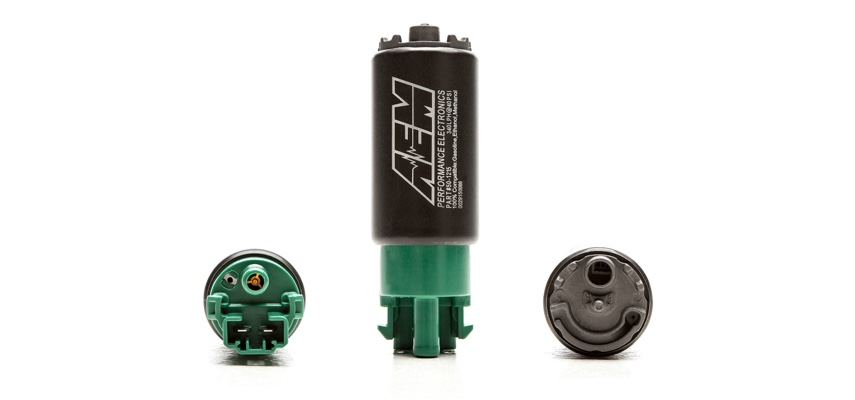

Most WRX and STI fuel pump upgrades start and end with a drop-in replacement. The pump slots into the factory basket, the wiring connects to the stock harness, and the job is done. For a large portion of builds, that approach works. However, serious E85 builds, surge tank configurations, and custom fuel system setups require something different. The AEM 340LPH 65mm Fuel Pump Kit with Mounting Hooks is built for those applications. It delivers 340 LPH at 40 PSI in a compact 65mm body with integrated mounting hooks, full ethanol compatibility, and the internal construction to handle sustained high-demand fueling on E85 and methanol blends.
This post covers what separates this kit from the standard drop-in format, which builds it suits, and how it fits into a complete Subaru WRX and Subaru STI fuel system upgrade.
What the 65mm Kit Actually Is
The AEM 340LPH 65mm kit is an in-tank fuel pump designed for universal mounting applications where standard drop-in pumps do not fit correctly. The distinction starts with the body length. Standard AEM in-tank drop-in pumps use a longer body engineered to fit directly into OEM pump mounting positions on specific applications. The 65mm body is shorter and more compact, which allows it to fit into fuel tanks with tight tolerances, custom baskets, and surge tank setups where the longer body physically cannot seat correctly.
The integrated mounting hooks are the other key difference. Rather than relying on an OEM basket to hold the pump in position, the mounting hooks allow the pump to be secured directly to a custom bracket, surge tank wall, or fabricated mounting point inside the fuel tank. This makes the 65mm kit the appropriate choice for builders doing custom fuel system work rather than a direct factory replacement.
Internally, the pump shares the same performance specification as the rest of the AEM 340LPH lineup. Flow is individually tested at 340 LPH at 40 PSI before the unit ships. The internal construction uses robust components specifically engineered to handle the low lubricity characteristics of ethanol and methanol fuels. Compatibility extends to E100 and M100, which covers every ethanol and methanol blend a WRX or STI build would reasonably encounter. The offset inlet design simplifies installation in tight spaces by reducing the clearance needed around the inlet port during fitment.
The kit includes the fuel pump, rubber sleeve and end caps, pre-filter, hose, clamps, and a flying lead for wiring. Because this pump draws 12 amps at 40 PSI and 15 amps at 80 PSI, factory fuel pump wiring is generally not sufficient to handle the current demand at higher pressures. A dedicated relay and appropriately sized wiring are part of a correct installation on any serious build.
Why Serious Builds Skip the Drop-In
The standard drop-in format works well for builds that stay close to the factory fuel system architecture. However, several common build scenarios push past what a drop-in pump can accommodate physically or functionally.
Surge tank setups are the most common example. A surge tank is a small secondary reservoir that sits inside or near the main fuel tank and keeps the pump fed with fuel during hard cornering, braking, and acceleration where fuel slosh can momentarily uncover a standard in-tank pump inlet. Building a surge tank requires mounting one or more pumps to a custom structure inside the tank, which the factory basket and drop-in format does not support. The 65mm body and mounting hooks make this configuration practical.
Twin-pump setups follow the same logic. As power targets climb and a single pump approaches its flow ceiling, running two pumps in parallel doubles available flow without requiring a larger single unit. Packaging two pumps in a tight tank environment requires compact pump bodies that can be positioned and secured independently, which is exactly what the 65mm hook-mount format enables.
Beyond physical packaging, the ethanol-compatible construction separates this kit from standard replacement pumps for any build running E85. Ethanol is corrosive to rubber seals, aluminum components, and pump internals not specifically rated for ethanol exposure. Running a standard pump on E85 accelerates internal wear and risks failure as the ethanol degrades components over time. Because replacing a fuel pump a second time costs more than choosing correctly the first time, starting with the E85-compatible kit is the more cost-effective decision for any build that involves ethanol now or in the future. The post on E85 vs pump gas on WRX and STI covers the full scope of what changes across the fuel system when making the switch.
Who This Pump Is For
The 65mm mounting hook kit suits WRX and STI owners who are past the point of a simple fuel pump swap. Specifically, the right buyer falls into one of three categories: owners building a surge tank or custom in-tank fuel system, owners running a twin-pump setup, or owners on serious E85 builds where the ethanol-compatible construction matters as much as the flow rate.
On power level, this pump supports builds in the 350 to 500 horsepower range on ethanol with correct injector sizing and tuning. Below that range on pump gas, the standard drop-in format is the simpler and equally capable choice. The post on AEM 340LPH fuel pump for WRX and STI covers the drop-in format and the power levels it supports, which helps clarify where the two options diverge.
For STI owners specifically, the fuel system conversation matters earlier in the build than most expect. The EJ257 fuel system architecture limits power potential independently of the block, and addressing fueling before or alongside engine work avoids the fuel system becoming an unexpected restriction point after significant investment elsewhere. The STI fuel system upgrades hub covers the complete fueling picture at each EJ257 power level. WRX owners can find the equivalent context at the WRX fuel system upgrades hub.
How E85 Changes the Fuel System Equation
Running E85 on a WRX or STI increases fuel volume demand by approximately 30 percent compared to pump gas at equivalent power levels. Ethanol has lower energy density than gasoline, so the engine needs more of it to produce the same power output. As a result, a pump that supports 400 horsepower on pump gas does not support 400 horsepower on E85 without additional fuel system capacity. This is why E85 builds consistently require a fuel pump upgrade as a core part of the conversion rather than an optional addition.
Additionally, the increased fuel demand changes how quickly a pump reaches its flow limit under boost. At high boost levels on E85, fuel pressure drops are more likely with an undersized pump, and pressure drops under load create lean conditions that damage engines. Therefore, matching pump capacity to the actual fuel demand of the build is not a detail to estimate loosely. The 65mm AEM kit at 340 LPH addresses the flow side of this equation for builds in its target power range, and the ethanol-compatible construction handles the chemical exposure side simultaneously.
For owners running or planning a flex fuel setup, the COBB flex fuel system allows the car to run any blend of pump gas and E85 with a single compatible tune. The post on COBB flex fuel upgrade for Subaru WRX covers how the flex fuel system works and what the build needs to support it.
Fuel Pump and Injector Sizing
A fuel pump upgrade at this level works in combination with injector sizing, not independently of it. The pump sets the ceiling on how much fuel the system can move, but injectors determine how that fuel is distributed across the combustion cycle. Upgrading the pump without addressing injectors on a high-power E85 build leaves the fueling system unbalanced and limits how effectively the pump’s capacity translates into actual power.
For WRX and STI builds targeting 400 horsepower and above on E85, upgraded injectors are part of the same conversation as the fuel pump. Fuel injectors sized correctly for the power target and fuel type prevent the injectors from becoming the restriction point once the pump is no longer limiting flow. The when you actually need bigger injectors on a WRX post covers the injector side of this decision in detail, including how to match injector sizing to a specific power and fuel combination.
Tuning ties both upgrades together. A professional custom tune calibrates the ECU to the new pump flow rate, injector sizing, and fuel type. Running a stock or off-the-shelf map with a significantly upgraded fuel system produces inaccurate fueling targets and undermines the investment in the hardware. For the full picture of what a WRX fuel system upgrade requires from pump through injectors through tuning, the fuel pumps vs injectors post covers how the two components interact and which to address first.
Shop the AEM 340LPH 65mm Fuel Pump Kit
The AEM 340LPH 65mm Fuel Pump Kit with Mounting Hooks is in stock and ships in 24 to 48 hours. Priced at $149.95.