
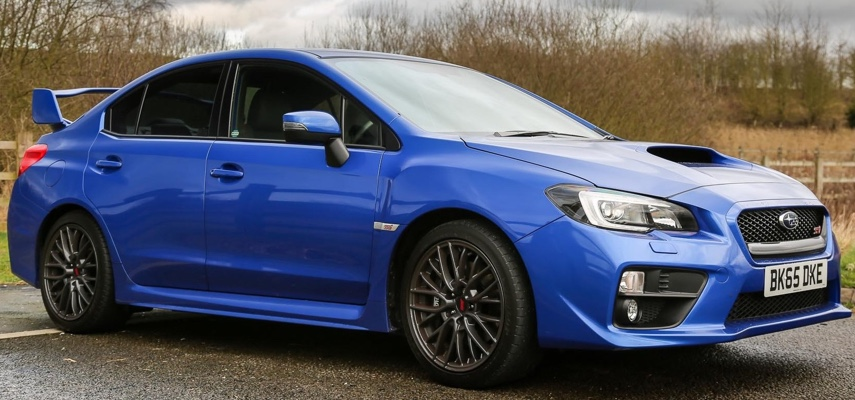

The stock STI turbo is one of the most capable factory turbos fitted to a performance car. It spools quickly, delivers strong mid-range power, and responds well to tune-based gains before needing replacement. But it has a ceiling, and most serious Subaru STI owners eventually reach it. This guide covers what the stock STI turbo actually makes, where it runs out, and when upgrading makes sense for your build.
What Turbo Does the Stock STI Run
The STI has used two main turbocharger generations across its production run. The 2004 to 2014 STI ran the VF39 turbo — a smaller unit with quick spool and a lower power ceiling. The 2015 to 2021 STI stepped up to the VF52, a larger and more capable unit that covers most of what current STI owners are working with.
The VF52 is a single-scroll turbocharger with an internal wastegate built by Mitsubishi Heavy Industries. It is a well-engineered unit that performs well at stock boost levels and supports meaningful tune-based power gains before the compressor map becomes the limiting factor. For most street-driven Subaru STI builds, the VF52 has more in it than the stock tune reveals.
How Much Power Does the Stock STI Turbo Actually Make
The 2015 to 2021 STI is factory rated at 305 HP at the crank. At the wheels, accounting for drivetrain losses through the AWD system, most stock STIs dyno between 250 and 270 WHP depending on conditions and dyno calibration.
The tune is where the VF52 starts to show what it can do. A COBB Accessport with an off-the-shelf map on 93 octane typically pushes the number to around 280 to 300 WHP. A pro tune on 93 octane moves that to approximately 310 to 330 WHP with proper supporting mods in place. On E85 with a flex fuel setup and a dialed pro tune, most well-supported STI builds on the VF52 land in the 340 to 370 WHP range. That is close to the practical ceiling of the stock turbo. Understanding how much boost is safe on a stock STI is important context before pushing the VF52 toward those upper numbers.
Where the Stock STI Turbo Runs Out
At sustained high boost on E85 with aggressive timing, the VF52 reaches the edge of its compressor efficiency map. The turbo is still producing boost but the air it delivers becomes increasingly hot and less dense as it operates outside its efficient range. Power plateaus. More boost does not produce more power because the turbo is working against the build rather than for it.
The practical ceiling for most VF52 builds is approximately 350 to 370 WHP. Pushing past that point on the stock turbo produces diminishing returns and puts stress on the turbo itself. Our post on the stock turbo vs upgraded turbo guide covers the full comparison between keeping the stock unit and stepping up to an aftermarket option.
Signs the Stock STI Turbo Is the Limiting Factor
Knowing when the VF52 is the restriction point rather than the tune or fueling saves time and money. Four specific signs indicate the turbo efficiency map is maxed out.
Power gains from tune adjustments flatten out despite headroom remaining in the fueling and ignition timing. Boost builds on the gauge but power at the wheels does not increase proportionally. Intake temps climb despite a properly sized intercooler upgrade, which indicates the turbo is generating excessive heat in the compressed air. The tune pulls timing to protect the engine even with adequate fueling and cooling in place. When all four show up together, the turbo is the limiting factor.
When to Upgrade the Stock STI Turbo
Under 330 WHP on 93 octane, the stock turbo is not the limiting factor. Focus on tune optimization and supporting mods before considering a turbo upgrade at that power level.
In the 330 to 370 WHP range, the VF52 ceiling is approaching. A turbo upgrade is worth planning for at this stage even if the stock unit is still delivering. Targeting 400 WHP and above makes the upgrade required rather than optional. The VF52 cannot support that power level reliably regardless of tune or supporting mods.
For STI owners running E85 aggressively at the VF52 ceiling, upgrading before pushing harder is the right call. Holding the stock turbo at the edge of its efficiency map under sustained use accelerates wear. Browse STI turbo upgrades to see what is available for the platform. The supporting mods guide for big turbo builds covers what needs to be in place before the upgrade goes in.
What STI Turbo Upgrades Are Available
STI turbo upgrades fall into two main categories. Drop-in upgrades use a larger compressor wheel in a housing designed to fit the stock turbo location. They maintain the stock turbo position, simplify installation, and deliver meaningful power increases without the complexity of a full big turbo kit. For STI owners targeting 400 to 450 WHP, a quality drop-in is often the most practical solution.
Full big turbo setups replace the stock unit entirely with a larger frame turbo. Spool is later than a drop-in but peak power and sustained high-boost efficiency are significantly better for builds targeting 450 WHP and above. The Boost Lab TD06SL2-54X for STI is a proven option in that range with STI-specific fitment. Browse STI turbo upgrade options to compare what is available, or explore turbocharger options for STI to see the full catalog.
Supporting Mods the STI Needs Before a Turbo Upgrade
A turbo upgrade on an unprepared STI does not make more power reliably. It creates more expensive failures faster. Every system that supports the turbo needs to match what the new unit can produce.
Fueling is the first priority. The fuel system upgrades guide covers injector and fuel pump requirements at big turbo power levels. A tune written for the specific turbo and mod combination is non-negotiable. At 400 WHP and above, the open-deck EJ257 block becomes the risk. The STI engine reliability guide covers how to protect the EJ257 at each power level. For builds pushing past 450 WHP, IAG short blocks for WRX and STI provide the closed-deck foundation the build needs to sustain that power reliably.
Plan Your STI Turbo Upgrade
The stock VF52 has real capability and responds well to tune-based gains before a hardware upgrade is needed. When the ceiling is reached, the upgrade path is well established and the STI platform has strong aftermarket support at every power level.
Browse the STI turbo and airflow upgrades hub to map out the full forced induction picture for the EJ257 platform. The Subaru STI performance upgrade guide covers how the turbo upgrade fits into the complete STI build sequence.