
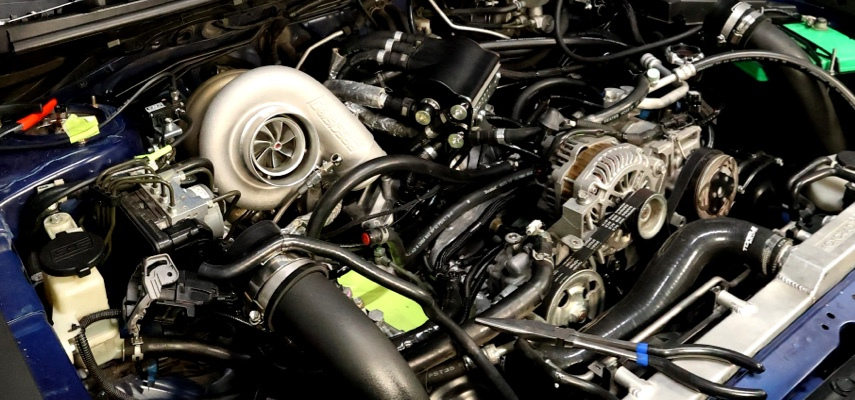

If you drive a Subaru WRX or STI, you are already running a turbocharged engine. That means your car depends on a carefully balanced forced induction system to control boost, manage airflow, and deliver safe, reliable power.
This guide explains how forced induction works, how boost is controlled, and how common upgrades can improve performance on both WRX and STI platforms.
What Is Forced Induction?
Forced induction refers to any system that compresses air before it enters the engine. On WRX and STI models, this is handled by a turbocharger. By forcing more air into the combustion chamber, the engine can burn more fuel and produce more power from the same displacement.
Unlike naturally aspirated engines, turbocharged setups rely on pressure and airflow management. That means every component in the system — from the turbo itself to the wastegate and intercooler — plays a critical role in both performance and reliability.
You can explore available components under the Forced Induction category.
How Turbochargers Create Boost
The turbocharger uses exhaust gases to spin a turbine wheel. That turbine is connected by a shaft to a compressor wheel on the intake side. As exhaust energy increases, the compressor spins faster, pressurizing incoming air and creating boost.
This pressurized air allows the engine to burn more fuel, resulting in higher horsepower and torque. However, as boost increases, so does heat and cylinder pressure, which is why proper tuning and supporting modifications are essential.
For higher horsepower goals, upgraded units such as the Boost Lab TD06SL2 20G Turbocharger or the Boost Lab TD06SL2 54X Turbocharger are common upgrade paths for STI builds targeting 450–500 horsepower. These larger turbochargers allow significantly more airflow than factory units, especially when paired with supporting upgrades such as improved fueling, efficient intercooling, and a properly designed performance exhaust system that helps the turbo move exhaust gases more efficiently.
The Role of the Wastegate
The wastegate controls how much exhaust gas reaches the turbocharger. By diverting excess exhaust flow away from the turbine, it regulates turbo speed and stabilizes boost pressure.
Without proper wastegate control, boost can spike unpredictably, leading to detonation or engine damage. On higher-powered builds, external wastegates offer improved precision and heat management compared to factory internal units.
Performance options are available under Wastegates, especially for higher boost builds or external conversions.
Boost Controllers: Precision Boost Management
A boost controller fine-tunes how and when the wastegate opens. Factory systems are conservative and designed for reliability. Aftermarket electronic boost controllers allow more aggressive yet controlled boost targets.
This results in improved spool characteristics, more consistent peak boost, and better overall drivability when properly tuned.
A popular upgrade for WRX and STI models is the COBB 3-Port Boost Control Solenoid, which improves boost response and control.
Browse more solutions in the Boost Controllers section or explore the broader COBB Tuning lineup.
Blow Off Valves and Turbo Bypass Valves
When you lift off the throttle under boost, pressurized air has nowhere to go. A blow off valve (BOV) or bypass valve releases this pressure to prevent compressor surge, which can damage the turbo over time.
Upgraded valves respond faster and hold higher boost levels compared to factory components, making them especially important on tuned or larger turbo setups.
Brands like Turbosmart specialize in high-performance boost control solutions. Popular options include the Turbosmart Gen-V RacePort BOV and the Turbosmart Supersonic BOV.
Explore additional valve options under Blow Off Valves and Turbo Bypass Valves.
Intercoolers: Cooling the Boost
Compressing air increases temperature. Hot air is less dense and more prone to knock, especially under higher boost levels. An intercooler reduces intake air temperature before it enters the engine.
Lower intake temperatures improve combustion stability, allow more aggressive tuning, and protect the engine from heat-related stress.
For example, the COBB Front Mount Intercooler improves airflow and cooling efficiency on higher boost setups.
See more options in the Intercooler Kits category.
Supporting Fuel and Tuning Upgrades
Increasing boost also increases fuel demand. More air without adequate fueling leads to dangerously lean conditions.
Proper ECU calibration ensures boost targets, ignition timing, and fuel delivery remain balanced. Every forced induction upgrade should be paired with professional tuning.
Explore EFI Tuning solutions and supporting components under Fuel Delivery to build a balanced setup.
Supporting Hardware for Higher Boost Builds
As turbochargers move more air and boost pressure increases, the engine and drivetrain experience greater stress. Supporting hardware upgrades help maintain stability and reliability as power levels climb.
Many Subaru builders install reinforced performance engine mounts to reduce drivetrain movement under load, especially on high-torque setups. Limiting engine movement helps maintain consistent power delivery and protects surrounding components.
Higher boost setups may also require stronger engine internals. Upgraded short blocks designed for high horsepower builds are available under the broader engine components category for drivers planning more aggressive power goals.
Common Mistakes When Increasing Boost
Many reliability issues occur when parts are installed without considering the system as a whole. Raising boost without upgrading fueling, ignoring intercooler efficiency, or pushing factory engine internals beyond their limits are common mistakes that can shorten engine life.
When power goals exceed stock limitations, many builds move toward reinforced short block solutions such as the IAG 950 EJ25 Closed Deck Short Block or the IAG 1150 Closed Deck Short Block, which are designed to handle significantly higher boost pressure.
Forced induction modifications should always be approached as a complete package — airflow, boost control, fueling, and tuning working together.
Increasing boost can quickly raise torque levels beyond factory tolerances. Before pushing PSI further, review our guide on FA20 and FA24 power limits to understand where stock components begin to reach their threshold.
Fuel choice also plays a major role in safe boost levels. Our E85 vs pump gas comparison explains how ethanol allows more aggressive tuning strategies.
Final Thoughts
Forced induction is what makes the WRX and STI so exciting to drive. When supported with quality components, careful tuning, and proper heat management, turbo upgrades can significantly improve performance while maintaining reliability.
Start building your setup by exploring the complete Forced Induction lineup.