
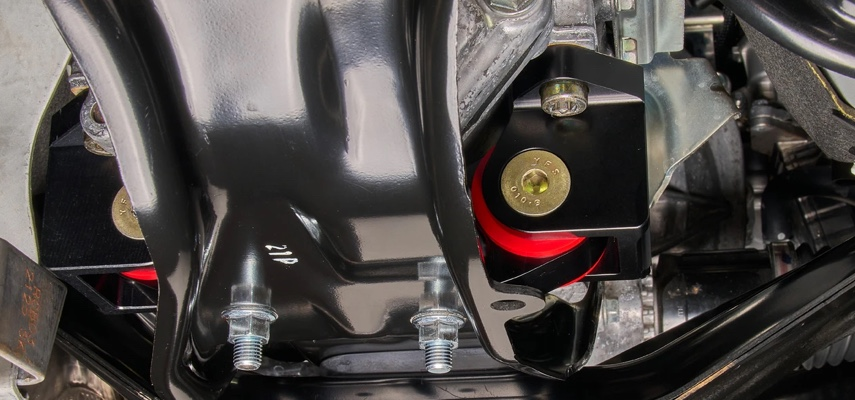

Upgraded transmission mounts are one of the least talked-about drivetrain upgrades on the WRX and STI and one of the most effective for improving shifting feel and drivetrain stability. The stock mounts use soft rubber designed to absorb vibration and prioritize cabin comfort. As power increases and the drivetrain takes on more load, that softness becomes a liability. This guide covers what transmission mounts actually do, when upgrading them makes sense, and what to look for on the Subaru WRX and Subaru STI.
What Transmission Mounts Actually Do
Transmission mounts secure the transmission to the chassis and absorb vibration generated by the drivetrain. The factory mounts use a soft rubber compound that does this job well at stock power levels. That same softness allows significant transmission movement under load. When the engine delivers torque through the drivetrain, the transmission physically moves in the engine bay. That movement has consequences throughout the drivetrain.
Upgraded mounts use stiffer rubber compounds, polyurethane, or billet construction to reduce that movement. The transmission stays more firmly located under hard acceleration, which keeps the shift linkage in a consistent position and improves how power is delivered to the wheels.
How Transmission Mount Movement Affects Shifting
The shift linkage connects the gear lever to the transmission. When the transmission moves under acceleration, the linkage moves with it. The gear lever ends up in a slightly different position than where the driver expects it. Gear engagement becomes inconsistent. Shifts feel notchy or imprecise. What feels like a transmission problem is often mount flex causing the linkage to move rather than anything wrong with the gears themselves.
Tightening up the mounts keeps the transmission in a fixed position relative to the shift linkage. Gear engagement becomes more consistent. The shift feel improves without touching the transmission internals. For anyone asking whether your WRX or STI needs a built transmission, checking the mounts first is worth doing before committing to a more expensive solution.
Stock vs Upgraded Transmission Mounts
Factory rubber mounts are soft by design. They reduce noise, vibration, and harshness inside the cabin effectively at stock power levels. The trade-off is drivetrain movement that becomes more significant as torque increases.
Performance rubber mounts use a stiffer rubber compound that reduces movement while maintaining reasonable street comfort. This is the right choice for daily-driven WRX and STI builds that want better drivetrain feel without adding excessive vibration to the cabin.
Polyurethane mounts are stiffer than performance rubber and reduce movement more aggressively. They transmit more vibration into the chassis, which is acceptable on a track car or a high-power street build where drivetrain precision matters more than cabin refinement. Billet mounts eliminate movement almost entirely and are reserved for competition builds where NVH is not a concern.
The same principle applies to engine mounts. The two upgrades work together — upgrading transmission mounts without addressing engine mounts leaves half the equation unsolved. Our post on what upgraded engine mounts do for WRX and STI covers the engine mount side of the picture in detail.
When Do You Actually Need Upgraded Transmission Mounts
For a stock or mildly modified WRX or STI driven primarily on the street, the factory mounts are adequate. The upgrade becomes relevant in several specific situations.
Running higher power levels puts more torque through the drivetrain on every pull. More torque means more movement in soft factory mounts. At a certain point the movement is noticeable and affects how the car feels under hard acceleration. Upgrading the mounts addresses the root cause rather than just living with the symptom.
Noticing drivetrain slop or inconsistent shifting is a clear signal. If gear engagement has become less precise or the shift lever feels vague, mount flex is often the culprit. Upgrading before the issue worsens protects the shift linkage and the transmission itself from the additional stress that comes with excessive movement.
Upgrading engine mounts is another trigger. Engine mounts and transmission mounts work as a system. Stiffening one side without the other creates an uneven drivetrain that still moves under load. Matching the transmission mounts to the engine mounts keeps the entire setup balanced.
A performance clutch upgrade is the third trigger. A stiffer clutch puts more load through the drivetrain every time the clutch is engaged. Stock mounts that were adequate before a clutch upgrade start to show their limits after it. Our post on clutch upgrades for WRX and STI covers the full clutch upgrade picture and where mounts fit into the equation.
IAG Billet Transmission Mount for WRX
For WRX owners who want a purpose-built solution rather than a universal mount adapted to fit, IAG Performance engineers their drivetrain components specifically for the EJ and FA Subaru platform. The IAG billet transmission mount for WRX uses billet construction to eliminate flex entirely. The fitment is direct replacement for the 2002 to 2020 WRX and the installation does not require modification.
For street builds where some compliance is preferred, a performance rubber or polyurethane option may be more appropriate. For high-power builds and track applications where maximum drivetrain stability is the priority, the IAG billet unit is the right call.
Transmission Mounts as Part of a Complete Drivetrain Upgrade
Transmission mounts work best as part of a complete drivetrain picture. Upgrading the transmission mounts alongside solid engine mounts for WRX and STI addresses the full mount system at once. The drivetrain stays stable on both sides and the improvement in shifting feel and power delivery is more significant than either upgrade alone.
For builds pushing into serious power territory, drivetrain stability is one of the supporting modifications that protects everything else. The WRX engine reliability guide covers how supporting modifications work together to protect the engine and drivetrain long term. Our post on supporting mods for big turbo WRX builds covers where drivetrain mounts fit into the complete big power build checklist.
Find the Right Transmission Mounts for Your WRX or STI
The right transmission mount depends on how the car is driven and what the rest of the drivetrain looks like. Performance rubber covers most street builds. Polyurethane suits track use and high-power setups. Billet is for competition builds where maximum stability is the priority.
Browse the full range of transmission mounts for WRX and STI to find the right option for your build and driving style.