Every hard launch, every shift, every burst of boost causes the engine and drivetrain to move slightly against their mounts. Most owners notice this as a feel issue, a slightly disconnected sensation under hard acceleration, but the actual cost goes beyond feel. That movement absorbs energy that should be going to the wheels, and over time it accelerates wear on components never designed to handle repeated flex. This post covers what is actually happening during that movement, why it matters beyond how the car feels to drive, and how to tell whether it is worth addressing on a specific build.
Why Factory Mounts Are Built to Move
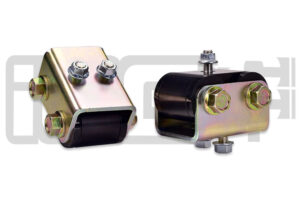
Factory engine and transmission mounts are tuned for comfort first, absorbing vibration and noise so the cabin stays quiet and smooth during normal driving. That same softness that makes daily driving pleasant becomes a liability under hard acceleration, since the engine and transmission can rock and shift against those soft mounts exactly when stability matters most. The post on do engine mounts improve performance on WRX and STI covers this tradeoff between comfort and stiffness in more detail.
This is not a design flaw so much as a design priority. Subaru engineered these mounts for the vast majority of owners who will never push the car hard enough to notice the tradeoff. It only becomes a real limitation once boost, power, and aggressive driving enter the picture.
Where the Power Actually Goes
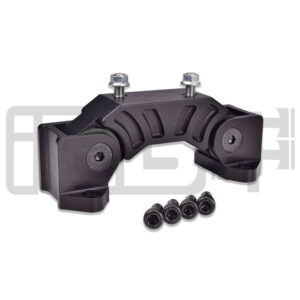
Every bit of engine and transmission movement absorbs energy that would otherwise transfer directly to the drivetrain and wheels. This is not a large percentage on any single mount, but it compounds across every mount point in the system, engine mounts, transmission mount, and the pitch mount that resists rotational movement under torque. On a car making serious power, that compounding effect becomes measurable rather than theoretical, showing up as inconsistent power delivery and a less direct connection between throttle input and actual acceleration.
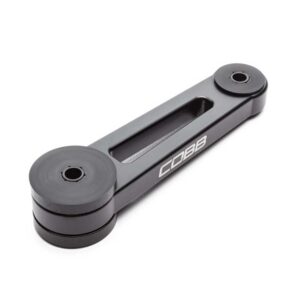
The pitch mount specifically addresses rotational movement, the engine wanting to rock forward and back around its mounting axis under hard acceleration and deceleration. The post on the COBB Pitch Stop Mount for Subaru WRX and STI covers this specific failure mode and what a stiffer mount changes.
How to Tell If Movement Is Actually a Problem
Not every car needs a mount upgrade, and it helps to know what to actually look for before assuming movement is costing meaningful power. Visible engine rock under hard acceleration, felt through the cabin or visible when popping the hood during a hard pull, is one of the more obvious signs. Inconsistent wheel spin patterns under boost, where power seems to surge unevenly rather than build smoothly, can also point back to mount movement rather than a tuning or turbo issue.
Aging factory mounts make this more pronounced over time, since rubber degrades and softens further with heat cycling and mileage. A car with 100,000 miles on factory mounts will show noticeably more movement than the same car at 20,000 miles, independent of any power increase, which is worth ruling out before assuming a power upgrade is the cause of new movement symptoms.
Wear That Compounds Over Time
Beyond the immediate power loss, repeated flex at soft mount points accelerates wear on components that were not designed to absorb that much repeated movement. Exhaust components, coolant lines, and wiring harnesses routed near the engine all experience more stress when the engine itself is allowed to move further than a stiffer mount setup would permit. This is part of why aging factory mounts sometimes correlate with seemingly unrelated issues elsewhere in the engine bay, the movement itself is the common thread even when the symptom shows up somewhere else entirely.
Exhaust hangers and heat shields are particularly prone to this, since they are rigidly mounted to the body while the engine and exhaust manifold move independently. Repeated flex at that junction over years of driving is a common source of rattles and premature hanger failure that traces back to mount movement rather than a defect in the exhaust itself.
The Transmission Side of the Equation
Engine mounts get most of the attention, but transmission movement matters just as much, particularly for shift quality and drivetrain lash. A transmission that shifts slightly under load changes shifter feel and can introduce play that feels like a worn shifter even when the shifter itself is fine. The post on do you need upgraded transmission mounts on a WRX or STI covers this side of the equation directly, and it often gets addressed alongside engine mounts rather than as a separate consideration.
Shifter Feel Is Part of the Same Picture
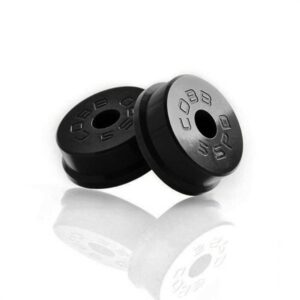
Drivetrain movement and shift linkage play are related but distinct problems. Even with stiff mounts eliminating engine and transmission movement, a shifter with excess play in the linkage itself still feels loose under hard shifting. The post on the COBB Short Throw Shifter for 2002 to 2007 Subaru WRX covers that side of drivetrain feel, and addressing both together tends to produce a noticeably tighter overall result than either upgrade alone.
Sequencing Mount Upgrades With the Rest of a Build
Mount upgrades tend to matter more as power climbs, which raises the question of when to actually address them in a build sequence. On a mildly modified car making close to stock power, factory mounts are rarely the limiting factor worth prioritizing. Once a build moves into bolt-on territory with real boost and power increases, mount movement becomes a more meaningful contributor to inconsistent power delivery, and that is typically when it is worth addressing rather than earlier in a build when other upgrades offer a bigger return.
Finding the Right Balance
Stiffer is not automatically better across the board. A fully solid mount setup eliminates movement almost entirely but transmits significantly more noise and vibration into the cabin, which most street-driven cars are not built to tolerate well long term. The goal for most builds is finding the stiffness level that meaningfully reduces power-robbing movement without crossing into daily driving harshness, which is why most performance mount upgrades use a firmer bushing rather than a fully solid design.
The WRX engine reliability upgrades hub and STI engine reliability supporting mods hub both cover how mount, drivetrain, and shifter upgrades fit together as a complete approach to tightening up how a build actually delivers power.
Frequently Asked Questions
How much power is actually lost to engine and drivetrain movement?
It varies by build and is difficult to quantify precisely with a single number, but the effect compounds across every mount point in the system. On a car making serious power, the cumulative effect becomes noticeable in power delivery consistency rather than remaining purely theoretical.
Should I upgrade engine mounts, transmission mounts, or the pitch mount first?
It depends on which movement is most noticeable on a given car, but many builds address all three together since they work as a system rather than independently. Reviewing which movement is most pronounced under hard acceleration helps prioritize where to start.
Will stiffer mounts make my car uncomfortable to drive daily?
A fully solid setup typically does increase noise and vibration meaningfully. Most performance mount upgrades use a firmer bushing rather than a fully solid design specifically to avoid that tradeoff while still reducing power-robbing movement.
How do I know if my factory mounts are actually worn out versus just soft by design?
Mileage and age are the biggest factors. A car with high mileage on original mounts will show more movement than factory spec, independent of power level, since rubber degrades over time. Comparing movement to a lower mileage example of the same platform can help distinguish normal factory softness from actual wear.