
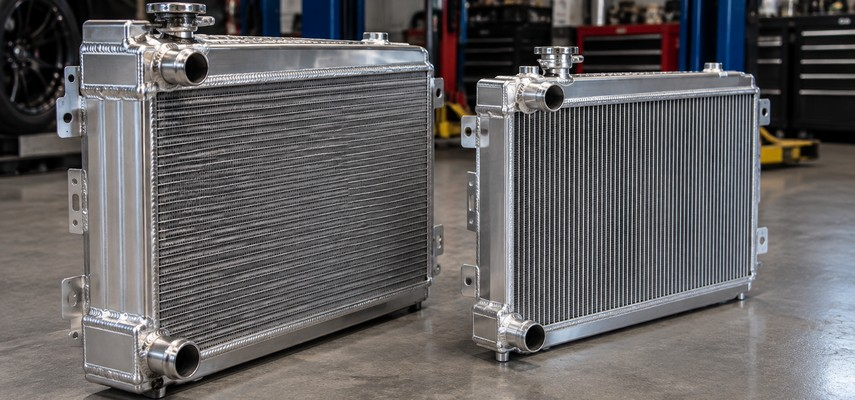

For a manual transmission 2008 to 2021 STI or 2008 to 2014 WRX, the Mishimoto Performance radiator is the best value, the Mishimoto X-Line adds a thicker three row core for harder use, and the Koyo Aluminum Racing Radiator suits owners who want the widest fitment from a single radiator or drive a manual 2015 to 2021 WRX. Year and transmission decide which of these radiators fits before brand comes into it, so that is the first thing to check. The sections below cover what each radiator changes and who should buy it.
Factory WRX and STI radiators use plastic end tanks, and those tanks expand and contract through thousands of heat cycles until they crack or leak. A leaking radiator on a boosted engine leads to overheating, and overheating leads to the head gasket and engine damage covered in the most common WRX engine failures guide. An aluminum radiator removes the plastic tank failure point and adds cooling capacity at the same time. Owners still deciding whether an upgrade is necessary should start with when you actually need an upgraded radiator, since this comparison assumes that decision is already made.
Check Your Year and Transmission Before Anything Else
Every STI from 2008 to 2021 came with a manual transmission, so the manual only limits below never apply to an STI. The WRX is different. Automatic and CVT cars need another solution, and the Koyo, the Mishimoto Performance, and the Mishimoto X-Line all require a manual transmission.
Generation matters just as much. The Mishimoto Performance and X-Line fit the 2008 to 2014 WRX and the 2008 to 2021 STI, and neither fits the 2015 to 2021 WRX, which runs the FA20 engine and needs a different radiator. A single Koyo part number covers the manual 2008 to 2014 WRX, the manual 2015 to 2021 WRX, and the 2008 to 2021 STI. Mishimoto sells a separate radiator for the 2015 to 2021 WRX, covered further down.
Koyo Aluminum Racing Radiator: The Widest Fitment in the Group
The Koyo Aluminum Racing Radiator uses all aluminum construction, heli-arc welded joints, and a machined billet filler neck. It fits the manual 2008 to 2021 WRX and the 2008 to 2021 STI, and it installs as a plug and play replacement that keeps the factory fan shroud and fan mounts. Owners report coolant temperature drops of 5 to 10 degrees in extreme heat compared to the factory radiator.
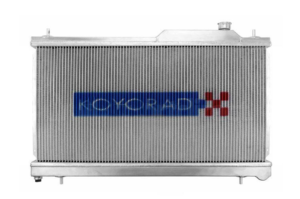
The Koyo is also the most expensive option here at about five hundred twenty dollars, and the radiator cap is sold separately. Koyo recommends its SK-C13 cap, and the factory cap also fits. The upper radiator hose may need minor trimming for clearance, so plan for that during installation. Owners who want a single radiator that covers either WRX generation or an STI get the most from this one.
Mishimoto Performance: The Value Pick for a Manual STI or 2008 to 2014 WRX
The Mishimoto Performance radiator uses a two row, 1.65 inch thick brazed aluminum core with TIG welded end tanks and a coolant capacity of about 2.21 gallons. Mishimoto rates it at up to 30 percent more cooling efficiency than the factory radiator. The kit includes a 1.3 bar radiator cap, a second cap for the expansion tank, a magnetic drain plug, and the Mishimoto lifetime warranty.
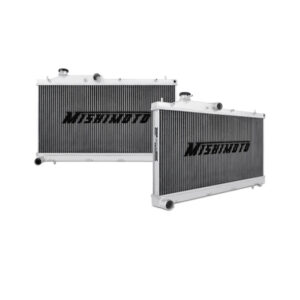
At about three hundred fifty dollars, this is the lowest priced radiator in the comparison. Installation needs one detail handled correctly, since Mishimoto specifies which cap belongs on the radiator and which belongs on the expansion tank, and the fitting size differs by model year. Following the instructions in the box avoids the two most common install mistakes with this radiator. More about the brand’s cooling lineup lives on the Mishimoto brand page.
Mishimoto X-Line: A Third Row for Harder Use
The Mishimoto X-Line radiator keeps the same fitment as the Performance radiator and adds a three row, 2 inch thick core. Mishimoto builds the tubes 16 percent thinner than stock for more surface contact, which gives the core more heat transfer area. The end tanks are polished and TIG welded, and the kit includes the same caps, drain plug, and lifetime warranty.
The X-Line costs about sixty dollars more than the Performance, at roughly four hundred ten dollars. Its extra row matters most for sustained heat, meaning track days, autocross, hot climates, and high boost EJ builds. Owners who read how much track use changes what a WRX or STI needs will recognize cooling as one of the first systems that track driving exposes.
2015 to 2021 WRX: Mishimoto Performance or Koyo
FA20 WRX owners have two choices. The Mishimoto Performance radiator built for the 2015 to 2021 WRX uses a two row, 1.34 inch core, and Mishimoto rates it at 117 percent more coolant capacity than the factory radiator, up to 15 percent better cooling efficiency, and coolant temperatures about 20 degrees Fahrenheit lower. It includes a 1.3 bar cap, a magnetic drain plug, and the lifetime warranty. Confirm transmission compatibility with the Wrench Masters team before ordering.
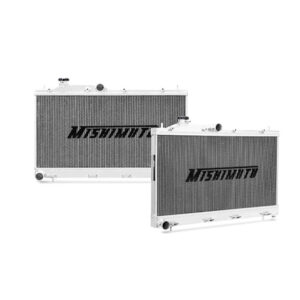
At about four hundred forty four dollars, it sits between the Mishimoto Performance and the Koyo in price. The Koyo also fits this generation on a manual, so the decision comes down to budget and warranty. Owners running the FA20 with more boost and a tune should treat cooling as part of the plan covered in supporting mods for big turbo builds.
How to Choose Between Them
Three questions settle most decisions. First comes fitment, meaning year and transmission, which rules options in or out before anything else. Second is how hard the car works, since a daily driven STI is well served by the Mishimoto Performance while a track car or a high boost build benefits from the X-Line or the Koyo. Third is budget and warranty, where Mishimoto offers a lifetime warranty on its radiators and the Koyo costs more than any Mishimoto in this list.
Cooling figures quoted here come from Mishimoto’s own ratings, and real results vary with climate, tune, and driving. For a deeper look at how much cooling a modified car actually needs, read how much cooling capacity a modified WRX or STI needs. The radiator is only one part of that system, and radiator versus intercooler versus oil cooler explains where each upgrade fits.
Builds following the reliable 400whp EJ257 build recipe or the perfect street STI build should plan the radiator alongside the rest of the reliability work on the engine reliability upgrades hub, since cooling protects every other part of the engine. Owners who want to browse further can start with the radiators category, and shoppers going by vehicle can also open the Subaru STI parts page and the Subaru WRX parts page.
Installation Notes Worth Knowing Before the Job
Plan on draining the cooling system, refilling with fresh coolant, and bleeding air from the system afterward, since trapped air causes false overheating readings. Inspect the radiator hoses while everything is apart, because old rubber hoses are a common leak source and cost little to replace during the same job. Follow each manufacturer’s cap instructions exactly, and check that every fitting and plug is tight before the first start.
Frequently Asked Questions
Which is better for a WRX or STI, Koyo or Mishimoto?
Neither is better in every case. The Mishimoto Performance is the lower priced choice for a manual STI or 2008 to 2014 WRX, the X-Line adds a third row for harder use, and the Koyo offers the widest fitment at the highest price.
Will the Mishimoto Performance radiator fit my 2015 WRX?
No. The Mishimoto Performance and X-Line radiators in this comparison fit the 2008 to 2014 WRX and the 2008 to 2021 STI. A 2015 to 2021 WRX needs the Mishimoto radiator built for that generation or the Koyo.
Do these radiators work with an automatic or CVT WRX?
The Koyo, the Mishimoto Performance, and the Mishimoto X-Line all require a manual transmission. Automatic and CVT owners should confirm compatibility before ordering. STI owners do not need to worry about this, since every STI in this range came with a manual.
Is the Mishimoto X-Line worth the extra money over the Performance?
It is worth it for cars that see sustained heat, such as track days, autocross, hot climates, and high boost builds. A daily driven car at moderate power is usually well served by the Performance radiator.
Do I need to replace anything else when I install an aluminum radiator?
Plan for fresh coolant and a proper bleed of the cooling system, and check the hoses while the job is open. The Mishimoto radiators include a 1.3 bar cap, while the Koyo ships without one, so add a cap to the order. On the Koyo, the upper radiator hose may also need trimming for clearance.
0 Comments for “Koyo vs Mishimoto Aluminum Radiator for WRX or STI”