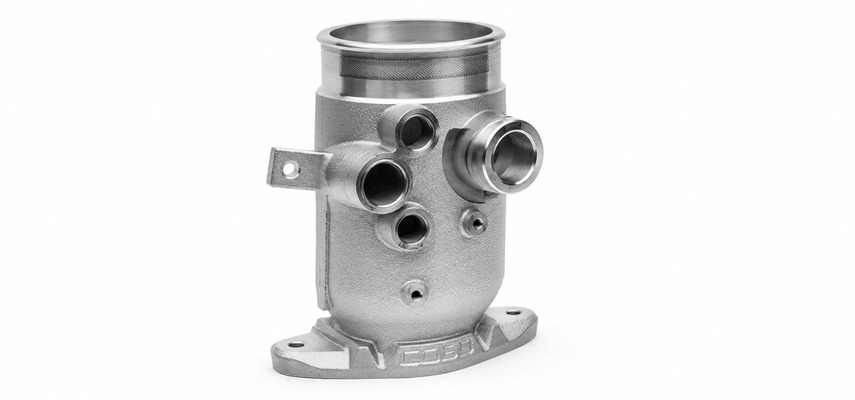
The factory turbo inlet on a 2015-2021 Subaru WRX is made of hardened plastic, and after years of heat cycling, that plastic becomes prone to cracking. A cracked inlet or a failed connector creates an air leak that is often difficult to diagnose, since the symptoms can look like several other issues before anyone traces it back to the inlet itself. The COBB Cast Aluminum Turbo Inlet replaces that factory piece entirely, and this post covers what changes with the upgrade and why it matters even on a car that has not shown any symptoms yet.
Why the Factory Inlet Is a Known Weak Point
Plastic works fine for a factory part under factory conditions, but heat cycling over years of driving gradually makes it brittle. Once cracks develop, whether in the inlet body itself or in the connectors attached to it, the result is an air leak that throws off the tune’s assumptions about airflow. This is exactly the kind of failure that tends to show up gradually rather than all at once, making it one of the more common surprises on a WRX that has otherwise had no engine problems.
What the Cast Aluminum Inlet Actually Changes
The COBB inlet is constructed from cast aluminum instead of plastic, which removes the heat cycling failure mode entirely. Beyond durability, the inlet diameter increases to 70mm, a 5mm gain over stock, and the outlet grows 2mm larger to match the factory compressor inlet at 50mm. That increase in airflow area is a real, measurable gain over the stock piece, not just a durability upgrade dressed up as a performance part.
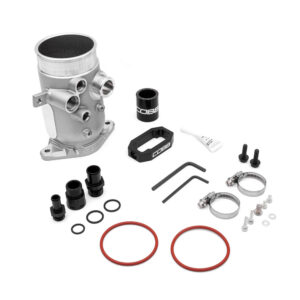
The factory BPV connection, another common failure point due to the brittle plastic used there, gets replaced with a reinforced silicone coupler. A captive o-ring on the turbocharger side keeps the seal tight during installation, and threaded ports sized for factory PCV and EVAP fittings are included, so nothing about the emissions or crankcase ventilation setup needs to be reworked to make it fit.
Built With Future Upgrades in Mind
The inlet includes mounting provisions for either the stock boost control solenoid or a COBB Electronic Boost Control Solenoid, which matters for anyone planning a boost control upgrade down the line rather than needing to revisit the inlet again later. Flats machined into either side of the inlet also allow auxiliary pressure or temperature sensors to be added, which is useful for anyone logging data more closely as a build progresses. The post on what happens when you run too much boost on a WRX or STI covers why reliable boost control and accurate sensor data both matter as power goals increase.
Where This Fits in a Turbo System Upgrade
An inlet upgrade like this pairs naturally with other airflow-focused work on the FA20 platform, since a factory-limited inlet can offset gains made elsewhere in the intake or turbo system. The WRX turbo and airflow upgrades hub covers how an inlet upgrade like this fits alongside intake, intercooler, and turbo sizing decisions on this platform.
Frequently Asked Questions
Do I need to replace the turbo inlet if mine has not cracked yet?
Not immediately, but the failure mode is progressive rather than sudden. Replacing a plastic inlet proactively, especially on an older or higher mileage FA20, avoids dealing with an air leak that can be difficult to diagnose once it does develop.
Does this inlet require a boost control solenoid to install?
No. It includes mounting provisions for either the stock solenoid or a COBB Electronic Boost Control Solenoid, so it installs correctly with whichever setup is already on the car.
Does upgrading the turbo inlet alone increase horsepower?
The larger inlet and outlet diameters do increase airflow capacity over stock, but the actual power gain depends on what else in the intake and turbo system is limiting airflow. It is best understood as removing one restriction rather than a standalone power upgrade.